
विवेचन सारांश
Paramātmā: Timeless And Transcendental
The fifteenth chapter is a very important chapter as it deals with jñāna yoga. In the earlier session, with reference to the stories of Sukhdev Muni and King Janak, we saw how to keep focus on Bhagavān despite performing all duties in life. Bhagavān repeatedly tells in the gītā to perform one's duty by following detachment. HE does not advise us to sacrifice material things and take up saṃnyāsa. Instead, HE tells us wherever we are, however we are, and whatever role we are in - we should perform our rightful duties with the mind hitched on to HIM alone.
As stated by Bhagavān,
निवसिष्यसि मय्येव अत ऊर्ध्वं न संशय: ||12.8||
15.6
na tadbhāsayate sūryo, na śaśāṅko na pāVākaḥ,
yadgatvā na nivartante, taddhāma paRāmaṃ(m) mama. 15.6
Paramātmā's loka (plane) is a one way ticket and there is no return to earth and suffering. This is our ultimate destination.
mamaivāṃśo jīvaloke, jīvabhūtaḥ(s) sanātanaḥ,
manaḥ(ṣ) ṣaṣṭhānīndriyāṇi, prakṛtisthāni karṣati. 15.7
Bhagavān says there is no first time, as it has always been that way. We with our limited thoughts think of the first or the beginning. Only if there is a beginning is there an end, and only if there is birth there is death. So it is very difficult to comprehend the limitless with our limited power of the mind. Bhagawan says not to worry as we are like HIM. Then why are we caught in this whirl? Bhagavān says that the five senses is ruled by the mind and because of the attraction of the senses, the Jīvātmā is bound with the body.
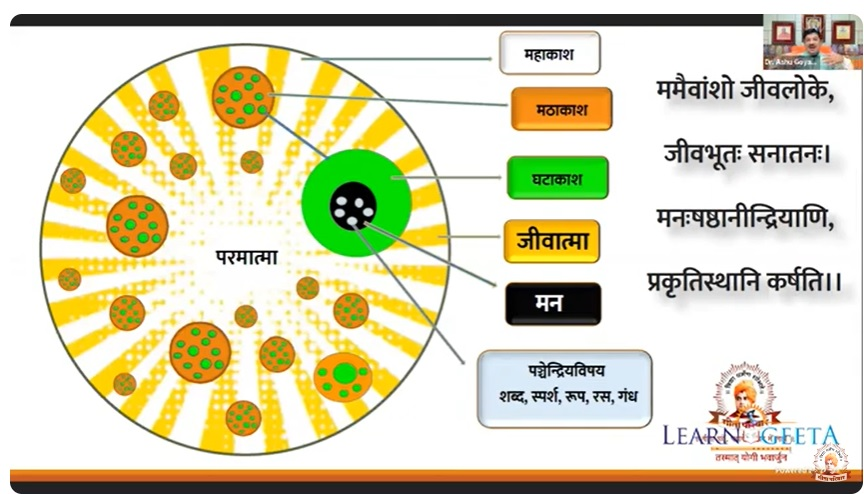
- Mahakash: The limitless Paramātmā, OM, Nirakaar, Saakar, Shakti, light, etc.
- Matakash: The ether outside our house, within the house, and in a glass are all the same. The temperature may be different for eg. 22 degrees, 30 degrees, 28/29 degrees respectively. Though ether is the same the properties are different in different environments. Similarly, Paramātmā is one and the same but appear different. The ether outside and in the pot is the same. If the pot is broken does the ether merge with the environment? It is always and same and remains the same.
- Ghatakash: Mahakash is the same in the earth, in the human body, the dog, in the tree, in the mountains, and rivers.
Bhagavān in the second chapter explains the qualities of the atma - it cannot be created or destroyed, it is not wet or dry, it does not get attached or do anything. Then how it goes from one body to another?
śarīraṃ(y̐) yadavāpnoti, yaccāpyutkrāmatīśvaraḥ,
gṛhītvaitāni saṃyāti, vāyurgandhānivāśayāt.15.8
If a small pen drive of 128GB or 1TB can carry lakhs of songs and movies then why cannot Paramātmā create a much advanced atma which can carry the memories of several births? The fragrance and stink can be likened to merits and sins. Just as the wind carries the smell so does the jeevatma. The body keeps changing and we keep learning new things? Why do we do it?
śrotraṃ(ñ) cakṣuḥ(s) sparśanaṃ(ñ) ca, rasanaṃ(ṅ) ghrāṇameva ca,
adhiṣṭhāya manaścāyaṃ(v̐), viṣayānupasevate.15.9
It is very common to see a photo of Sri Krishna playing the flute and deers around HIM. Man being intelligent knows this fact. He hunts the deer for kasturi which is very expensive. So, he plays the music. The deer's ears prick up and gets lost in the music. Though the deer is very alert, its mind becomes engrossed in the music which enables the hunter to take the kasturi and leave it to die. The fast-running deer is killed because of its love for music.
4. Sparśanaṃ: Skin and the capacity to feel by touch. Elephant is a strong and huge animal. Lion the king of the jungle never attacks the elephant. The ring master in a circus makes the elephant salute, stand on two legs, and sit down. The weakness of the elephant is its sense of touch. To catch an elephant easily the day of amavasya is chosen when there is total darkness. A pit of 8'*8' is made, and net placed.
A wooden structure of a female elephant is placed behind the net. The wooden structure is smeared with the dung of the female elephant and its sound is played. An elephant has sharp ears and gets to hear the sound of its mate even when 2 kms away. The elephant runs in the direction of the sound and sees the figure of the mate from far. As it picks up speed and because of the darkness fails to observe the pit and falls into it. It trumpets and struggles to get out of the pit and in the process incur several wounds. After intense struggle for four hours, it dawns upon it that it is impossible to get out.
For the next three days the mahout watches the trapped elephant from afar. In this time span it gets angry, trumpets, is hungry and thirsty, as well as tired. On the third day the mahout brings some bananas and rotis and sees the angry elephant. It devours the food after some time. The fourth day, the mahout brings more rotis.
On the fifth day the elephant waits for him to bring the food. On the fifth day the mahout brings not food but a stick. He commands the elephant with it. The elephant being hungry understands within an hour that if it obeys the mahouts' orders expressed through the stick it gets food. If he sways the stick to the right the elephants move in that direction. When he sways the stick to the left the elephant moves to the left. In six hours of training with the stick the mahout feeds the elephant and returns.
On the sixth day the elephant becomes focused on the stick as it knows very well that if it obeys the orders, it will get food and the mahout gives the elephant advanced training and teaches it to stand on two legs. The mahout being experienced trains the elephant for nearly six hours.
On the seventh day the elephant dances to the tune of mahout's orders.
By the eighth day when the mahout is totalling convinced that the elephant obeys the orders, he puts a ramp and fastens the elephant with a rope. With the help of other elephants, he retrieves the elephant from the pit. The elephant which was in the wild and strong now obeys the orders of the mahout for the rest of its life for food. Seven days before the elephant would have thrown the mahout. But because of its affinity to touch it becomes a slave for life.
5. Ghrāṇa: Nose and the capacity to smell. The lyrics of the song by Narendra Sharma:
What effect will have on the human body endowed with all the five senses? It is because of the attraction by the five senses that we are trapped in the cycle of birth and death.
utkrāmantaṃ(m) sthitaṃ(v̐) vāpi, bhuñjānaṃ(v̐) vā guṇānvitam,
vimūḍhā nānupaśyanti, paśyanti jñānacakṣuṣaḥ.15.10
yatanto yoginaścainaṃ(m), paśyantyātmanyavasthitam,
yatanto'pyakṛtātmāno, nainaṃ(m) paśyantyacetasaḥ. 15.11
It can never happen! Without the purification of the mind knowledge cannot be attained how much ever it is nice to hear and speak about. It is easier to find people who speak well but a person with pure mind is difficult to meet.
In the next four verses Bhagavān condenses from the macro to micro level and explains his power in different levels.
yadādityagataṃ(n) tejo, jagadbhāsayate'khilam,
yaccandRāmasi yaccāgnau, tattejo viddhi māmakam. 15.12
gāmāviśya ca bhūtāni, dhārayāmyahamojasā,
puṣṇāmi cauṣadhīḥ(s) sarvāḥ(s), somo bhūtvā rasātmakaḥ. 15.13
ahaṃ(v̐) vaiśvānaro bhūtvā, prāṇināṃ(n) dehamāśritaḥ,
prāṇāpānasamāyuktaḥ(ph), pacāmyannaṃ(ñ) caturvidham.15.14
- Jatharagni – one Agni present in the stomach and duodenum.
- Bhutagni – five Agni from five basic elements.
- Dhatwagni – seven Agni present, one in each of the seven dhatus.
There are four types of food viz:
2. Peya - Liquid food like milk.
3. Lehya - Food that can be licked like honey.
4. Choshya - Food that can be sucked like pickle.
1. Prāṇa
3. Udana
4. Vyana
5. Samana
Even if we hang upside down and have food, the food does not fall down. Instead, it is chewed in the mouth and passes through the esophagus to the stomach, and intestines.
sarvasya cāhaṃ(m) hṛdi sanniviṣṭo,
mattaḥ(s) smṛtirjñānamapohanaṃ(ñ) ca,
vedaiśca sarvairahameva vedyo,
vedāntakṛdvedavideva cāham. 15.15
3. Apohan - The meaning of 'pohan' is doubt - to know what is right and wrong and to know what to do. Apohan is clarity on such doubts. Clarity of intellect to know what is right. That is why experience is better than book knowledge. That is why we consult elders, great industrialists, great scientists, and saints. Knowledge can be acquired but clarity of intellect is with the experienced. Apohan is the power of Paramātmā.
dvāvimau puruṣau loke, kṣaraścākṣara eva ca,
kṣaraḥ sarvāṇi bhūtāni, kūṭastho'kṣara ucyate. 15.16
- Perishable × Imperishable
- Kṣetra × Kṣetra-jña (field × knower of the field)
- Kshar x Akshar (perishable × Imperishable)
- Prakṛti × Puruṣa (Creative force × Creator)
- Jad × Chetan (gross × subtle)
- Deha × Dehi (Dwelling, the body × Dweller, the Ātman)
- Jeev × Bhagavān (the being × that which becomes, Ishvara)
uttamaḥ(ph) puruṣastvanyaḥ(ph), paramātmetyudāhṛtaḥ,
yo lokatrayamāviśya, bibhartyavyaya īśvaraḥ. 15.17
yasmātkṣaRāmatīto'ham, akṣarādapi cottamaḥ,
ato'smi loke vede ca, prathitaḥ(ph) puruṣottamaḥ. 15.18
yo māmevamasammūḍho, jānāti puruṣottamam,
sa sarvavidbhajati māṃ(m), sarvabhāvena bhārata. 15.19
As Mira bai sang:
iti guhyatamaṃ(m) śāstram, idamuktaṃ(m) mayānagha,
etadbuddhvā buddhimānsyāt, kṛtakṛtyaśca bhārata. 15.20
कायम ना जग का झमेला रहेगा।
किस काम ऊँचा जो तू, महला बनाएगा,
किस काम का लाखो का जो,
तोड़ा कमाएगा,
रथ हाथियों का झुण्ड भी,
किस काम आएगा,
जैसा तू यहाँ आया था,
वैसा ही जाएगा,
तेरी सफर में सवारी की खातिर,
तेरी सफर में सवारी की खातिर,
कंधो पे ठठरी का ठेला रहेगा,
रे मन यें दो दिन का मेला रहेगा,
कायम ना जग का झमेला रहेगा।।
कहता है ये दौलत कभी,
आएगी मेरे काम, पर यह तो बता धन हुआ,
किसका भला गुलाम,
समझा गए उपदेश, हरिश्चंद्र कृष्ण राम,
दौलत तो नहीं रहती है, रहता है सिर्फ नाम,
छूटेगी सम्पति यहाँ की यहीं पर,
तेरी कमर में ना अधेला रहेगा,
रे मन यें दो दिन का मेला रहेगा,
कायम ना जग का झमेला रहेगा।।
साथी है मित्र गंगा के, जल बिंदु पान तक,
अर्धांगिनी बढ़ेगी तो, केवल मकान तक,
परिवार के सब लोग, चलेंगे मशान तक,
बेटा भी हक़ निभाएगा, तो अग्निदान तक,
इसके तो आगे भजन ही है साथी,
हरी के भजन बिन तू अकेला रहेगा,
रे मन यें दो दिन का मेला रहेगा,
कायम ना जग का झमेला रहेगा।।
In the Upanishad of the Bhagavadgītā, the subject of which is the knowledge of Brahman, the science of yoga, the dialogue between Sri Krishna and Arjuna, constituting the fifteenth chapter 'Puruṣottama yoga' is complete.
The session concludes with 'Hari sharanam.'
Question and Answer session:
Ashish Ji
Question: Why should this chapter be read upon death of a person.
Answer: Bhagavān has likened this chapter to Śāstra. Further, it is not necessary for the atma to enter into a new body immediately upon death of an individual. It is believed that for upto ten days the atma remains in unfettered hence people chant the gītā, garuda purana, etc.
Mahalakshmi Ji
Question: With reference to verse 8, does not the mind and senses change in each birth?
Answer: The body is perishable and gets destroyed upon death but the likes and dislikes and other qualities gets carried over to the next birth. That is why as children some are quite and some troublesome.
Sakshi Ji
Question: Importance of learning the gītā and why do children get into serious trouble?
Answer: It is better to focus on the right pronunciation while learning the gītā and then focus on the meaning to delve in later. Children are born with the baggage of previous births. Further, the culture and traits of the dynasty has a bearing which includes that of parents, grand parents, etc. The environment in which the child grows also affect his nature - like if he is raised in the house of a drunkard or family into bhajans and gītā.
Also the school, friends, and company also affect the nature. We do not have control over the actions of previous births and dynasty traits. But the environment and other settings like what we read, what we see has a profound influence on our nature.
Vishal Ji
Question: How to identify truth and lie?
Answer: There is no absolute truth or lie. It is a matter of perspective. While a person sitting in America experiences day and the one in India experiences night at the same time. The truth is relevant only for that particular location. Truth and lie depend on the place, situation, and perspective. There are some universal truths that never change like the presence of the sun.
What you see and hear may not be the entire truth and so our culture seeks the perspective of the experienced and saints. As we age and gain knowledge and experience we are able to perceive the truth better. Gandhi Ji used to say that if he has said two contradictory statements, then what he said last is the one to be taken as he is also evolving with time.
Question: Chapter 15 verse 16 clarification.
Question: Meaning of sanatana in 15:7
Answer: There are two words: Puratan and sanatan. Puratan is ancient without any timeline like the existence of the sun. Sanatana is that which was always there, eternal. Eg. jeevatma. Hindu dharma is also referred to as sanatana dharma as it was not propagated by a single person.
Anil Ji
Question: How not to have expectations and how to deal with people who hurt us?
Answer: We do not forget but try to remember and recall those who harm or insulted us. If a person whom we like hurt us, we try to ignore. If we do not think about the incident we tend to forget. A binocular is used for distant vision. People who harm us should be viewed from far so that we forget easily. One should do this for one's own peace of mind.
Shraddha Ji
Question: I see Vishnu Ji in all idols in a temple.
Answer: We have to pray to all deities with the favourite deity in mind. This is the best form of worship. All forms of Parameśvara are the same.
Mitali Ji
Question: What is the first step on learning the gita?
Answer: For good health one should drink milk and on drinking milk one gets good health. One should consciously strive to purify the mind. One can improve step by step.
Naresh Ji
Question: What is antahkaran, how to purify it and how do we know that it is purified?
Answer: We have a gross body and subtle body (sookshma sharir) which is called antahkarana. It is made up of mind, intellect, ego, and consciousness. Mind comprises of thoughts - both well planned (sankalp) and otherwise (vikalp). The intellect helps in differentiating between the right and wrong.
Whatever actions we perform from morning to night - we should bring sattvic guna into it by eating right, doing good, seeing and reading right, etc. so naturally sattvic qualities increase resulting in purification of the mind.
Gayatri Ji
Question: If shraddha increases actions will be reduced?
Answer: When we have devotion to Bhagavān it implies it is good for our welfare. If we are attached to material things it will only lead to our destruction.
om tatsaditi śrīmadbhagavadgītāsu upaniṣatsu brahmavidyāyāṃ(y̐)
yogaśāstre śrīkṛṣṇārjunasaṃvāde puruṣottamayogo nāma pañcadaśo'dhyāyaḥ.

We are sure you enjoyed reading the Vivechan write- up. Please invest three minutes of your time to provide us your feedback. Use the link below:
https://vivechan.learngeeta.com/feedback/
Thank you-For reading the summary
You have enjoyed this vivechan writeup! In spite of intense editing and proofreading, errors of grammar, as also of omission and commission may have crept in. We appreciate your forbearance.
Jai Shri Krishna!
Compiled by: Geeta Pariwar – Creative Writing Department
Har Ghar Gītā, Har Kar Gītā !
Let’s come together with the motto of Geeta Pariwar, and gift our Geeta Classes to all our Family, friends & acquaintances
आओ गीता सीखें, विशुद्ध उच्चारण के साथ
Learn Geeta, Spread Geeta, Live Geeta
|| OM ŚRĪKṚṢṆĀRPAṆAMASTU ||