
विवेचन सारांश
Soulful Surrender: Delving into the Depths of Bhakti Yoga
The 12th chapter of the Bhagavadgītā is Bhakti-Yoga - The Yoga of Devotion.
Today's session commenced with lighting of the holy lamp followed by obeisance to Śrī Bhagavān and Gurudev.
The abundant blessings of the Divine have graced our fortune. We have immersed ourselves in the study, contemplation, and reflection upon the teachings of the Bhagavadgītā. It is uncertain if we have accrued any merits in this current lifetime; perhaps some of it is the result of virtuous deeds from our past lives. Could it be the blessings of our ancestors or the benevolence of a saint in some previous birth that has shaped our destiny? It is through such factors that our fortunes have unfolded.
We have started reading and delving into the wisdom of the Bhagavadgītā, and it is not an achievement solely through our efforts. This is not attainable without the grace of the Divine. The reason being, as explicitly stated by the Divine in the 18th chapter of the Bhagavadgītā, those who read and contemplate upon its verses attain a higher state of connection with the Divine.
भक्तिं मयि परां कृत्वा मामेवैष्यत्यसंशय: || 68 ||
Those who have accumulated merits over many lifetimes are blessed by Śrī Bhagavān. We should never think that we chose the Gītā class. We have been chosen to read the Gītā. In the last 5300 years, great individuals from various cultures worldwide have contemplated the Bhagavadgītā and praised it. Moreover, it has been observed in most places that there is simply no other scripture comparable to the Bhagavadgītā.
The Bhagavadgītā, in its entirety, refrains from prescribing specific rituals such as worship procedures. It abstains from delving into these aspects. Its universal appeal lies in the fact that individuals from any tradition can easily grasp its teachings. Śrī Bhagavān, in the Gīta, refrains from criticizing or condemning any particular belief system. Notably, the scripture contains a remarkable assertion absent in any other text.
In Chapter 4, Verse 11, Sri Bhagavān proclaims:
ये यथा मां प्रपद्यन्ते तांस्तथैव भजाम्यहम् ।
मम वर्त्मानुवर्तन्ते मनुष्याः पार्थ सर्वशः ॥
ye yathaˉ maˉm˙ prapadyante taˉṃstathaiva bhajaˉmyaham
mama vartmaˉnuvartante manuṣyaˉḥ paˉrtha sarvasˊaḥ
Translated, this shloka conveys: "In whatever way people surrender unto Me, I reciprocate accordingly. Everyone follows My path, knowingly or unknowingly, O son of Pritha."
In essence, Śrī Bhagavān underscores that HE responds to individuals based on their unique approach and worship. Such profound insights, uniquely found in the Bhagavadgītā, emphasize the idea that one can worship God in any form or by any name.
Let's begin the contemplation of Chapter 12. Before that, it's essential to understand what the Bhagavadgītā is. Duryodhana deceitfully sent the Pāṇḍavas into thirteen years of exile. Even upon their return, Duryodhana denied them their rightful kingdom.
Śrī Krishna, acting as a peace envoy, proposed giving just five villages to the Pāṇḍavas, but Duryodhana adamantly refused. He insisted on not giving even a piece of land equivalent to the point of a needle in the earth. Yudhishthira and Bhagavān Krishna both sought to avoid war. Various emissaries were sent, and ultimately, Bhagavān Krishna personally went as a messenger.
In the end, Queen Kunti sent a messenger to Yudhishthira, conveying that he, as a warrior, should uphold his duty. She ordered him to prepare for war to rectify the injustice that Duryodhana was inflicting upon his subjects. Following Queen Kunti's directive, Yudhishthira accepted the proposal for war.
Months were spent in war preparations. Firstly, a suitable battlefield was sought, a vast arena where a massive army could assemble, with facilities for elephant stables and sacrificial altars. It needed to be a pilgrimage site where soldiers who died in battle could attain heaven. Kurukshetra was chosen. For months, armies arrived from all corners of Bharat, and infrastructure like bridges, wells, granaries, and horse encampments were constructed. After months of meticulous preparation, immense armies gathered on the battlefield.
The date of the impending war was set, and as the armies faced each other on the battlefield, a crucial conversation unfolded between Bhagavān Krishna and Arjuna. At Arjuna's request, his chariot was positioned amid both armies, allowing him to observe the forces arrayed on either side. It was at this pivotal moment that Arjuna grappled with a profound dilemma, overwhelmed by confusion and intense emotions. The decisive hour for the commencement of the war had arrived, with preparations in full swing on both sides. At this critical juncture, Arjuna openly declared his reluctance to participate in the impending battle.
Immersed in a state of delusion, Arjuna disclosed his inner turmoil and expressed his unwillingness to engage in the conflict. This marked the beginning of a significant dialogue between Śrī Krishna and Arjuna, during which, in approximately 45 minutes, Bhagavān Krishna bestowed divine knowledge upon Arjuna—a timeless wisdom destined to echo through the ages. Recognizing the transformative potential of the moment, Bhagavān Krishna chose to deliver universal teachings for the benefit of humanity. Using Arjuna as a conduit, he conveyed the immortal wisdom encapsulated in the Bhagavadgītā, intended to promote the well-being of all mankind.
Some may ponder the reason behind commencing the study of the Bhagavadgītā with Chapter 12. This practice has deep roots in tradition and suggests that for those encountering the Gītā for the first time, starting with the 12th chapter is advisable. Consider an analogy for better understanding. Gate Way of India is a monument built by the British in Mumbai in 1913. Initially, it served as the arrival point for the British entering India by sea. However, as India's capital shifted to Delhi, the British responded by constructing the India Gate in Delhi in 1921. India Gate doesn't demarcate any geographical boundary within India; it is symbolic. But why was it erected? To enter the heart of India, a gateway is essential, and India Gate serves that purpose. It symbolizes the entry point, signifying that to truly comprehend India, one must pass through India Gate.
For those wishing to explore the outer layers of the Bhagavadgītā, commencing with Chapter 1 is akin to entering through the Gateway of India. However, if the intention is to delve into the core or essence of the Gītā, Chapter 12 functions like India Gate—an entry point to access the heart or essence of the teachings. This chapter serves as the key to unlock the profound spiritual wisdom encapsulated in the Bhagavadgītā. Despite being the shortest with only 20 verses, Chapter 12 holds immense significance as it delves into the path of devotion (Bhakti yoga). Even if one has mastered only this chapter, they have acquired the essence of devotion. What could be more auspicious than that? In contrast, the first chapter, Arjuna's despondency, may impart only the art of lamenting, offering little real benefit. However, by learning just one chapter and embracing devotion, individuals receive unparalleled blessings. Therefore, in the ancient tradition of Gītā study, initiation often commences with Chapter 12.
The term "Yoga" is used for all chapters of the Gītā. The name of this chapter is Bhakti Yoga. The 15th chapter, is named Purushottama Yoga. Then, the 16th is called the Daivāsura Sampad Vibhāg Yoga. The first chapter is named Arjuna Viṣhād Yoga (Arjuna's Dilemma). So, what is Yoga? The literal meaning of Yoga is to connect, to get connected. Yoga is to get connected and, conversely, to disconnect is Viyoga. The path through which one connects with the divine is Yoga. The Bhagavadgītā is a direct conversation between Śrī Krishna and Arjuna, lasting for 40-45 minutes. However, dividing it into 18 chapters was the gracious act of Bhagavān Vyasa to aid our understanding. This division helps us better comprehend each chapter.Many people confuse Śrīmad Bhagavatam and Bhagavadgītā. Śrīmad Bhagavatam is one of the 18 Puranas, narrating the divine exploits of Bhagavān Krishna. You might have heard or seen the narrative spanning seven or nine days. Śrīmad Bhagavadgītā is not a separate scripture; rather, it is part of the Mahabharata, the world's largest epic consisting of 100,000 shlokas.
Within the Mahabharata, there are 18 parvas (sections), one of which is named Bhīṣma pitāmaha Parva. From its 25th to 42nd chapters, the Bhagavadgītā is found. It is a conversation sung by Śrī Krishna, who is referred to as the divine. A scripture is named after the person who sings it, and since it was sung by Śrī Krishna, it is called Bhagavadgītā. There are 700 shlokas in the 18 chapters. One (first) shloka is spoken by Dhritarashtra, 41 by Sanjaya, 84 by Arjuna, and the remaining 574 shlokas are pronounced by Śrī Krishna. It's important to note that Bhagavān Ved Vyasa, a divine seer, wrote the Mahabharata and the Gītā, possessing the ability to perceive past, present, and future simultaneously. This divine vision allowed him to grant Sanjaya a similar sight, enabling him to narrate the events to Dhritarashtra.
The reference to the Bhagavadgītā within the Mahabharata holds significant importance. The epic battle spanned over 18 days, and on its tenth day, Bhīṣma Pitāmaha remained laid on a bed of arrows. Sanjay, tasked with delivering this crucial news, returned to Hastinapura, departing from the battlefield. Up until then, Sanjay had been a witness to the ongoing conflict. At this juncture, Dhritarashtra intervenes, urging Sanjay to provide a comprehensive account. Dhritarashtra states, "Stop, Sanjay! Narrate everything from the very beginning."
धृतराष्ट्र उवाच |
धर्मक्षेत्रे कुरुक्षेत्रे समवेता युयुत्सवः |
मामकाः पाण्डवाश्चैव किमकुर्वत सञ्जय ||1||
"In the sacred expanse of Kurukshetra, where the forces were assembled for battle, what transpired between my sons and the sons of Pandu? Enlighten me, Sanjay."
At this pivotal moment, the Bhagavadgītā unfolds. Sanjay, blessed with divine insight, commenced the narration, presenting the entire discourse to Dhritarashtra.
The question may arise in someone's mind: "I am a devotee of Śrī Rama, I am a devotee of Bhagavān śiva. The Bhagavadgītā was spoken by Śrī Krishna. So, what relevance does it have for me?" An exceptionally crucial point to understand in response to this query is that throughout the 100,000 verses of the Mahabharata, whenever Śrī Krishna speaks, Bhagavān Vyasa, the divine sage, addresses HIM as Keshava, Śrī Krishna, or Vasudeva. Only in the Bhishma Parva, from the 25th chapter to the 42nd chapter, encompassing the 18 chapters known as the Bhagavadgītā, is HE referred to as Śrī Bhagavān, the Supreme Divine Being. When Śrī Krishna speaks here, HE is addressing as the Supreme Brahmān, not in His specific form as Śrī Krishna. Therefore, for those who adore Śrī Rama, HE speaks as Śrī Rama; for those devoted to Bhagavān Shiva, HE speaks as Bhagavān Shiva; for those who revere Goddess Durga, HE speaks as Durga. When Śrī Bhgavan says,
सर्वधर्मान्परित्यज्य मामेकं शरणं व्रज |
अहं त्वां सर्वपापेभ्यो मोक्षयिष्यामि मा शुच: ||
Abandon all varieties of dharmas and simply surrender unto Me alone. I shall liberate you from all sinful reactions; do not fear.
Herein "Māmekam śaraṇam vraja" implies taking refuge in your chosen deity.
Whether you have devotion to Śrī Krishna or any other deity, the Bhagavadgītā is relevant for you because it is the words of the Supreme Being. Wherever you read the Gītā, you will find the words "Śrī Bhagavān uvaach," not "Śrī Krishna Uvaach."
Before delving into the teachings of the Bhagavad Gītā, it is crucial to grasp the appropriate mindset required for such profound wisdom. To exemplify this, let's delve into a story from a bygone era featuring Narayanaswami, a devout soul, and Shravan, a learned scholar. While Narayanaswami trod the path of devotion, Shravan delved into the realms of knowledge.
For an extended period, Shravan grappled with uncertainties on his spiritual journey. One day, feeling inspired by the devotion radiating from Narayanaswami, he approached him with a humble request, "Observing your divine devotion, I am compelled to seek its wisdom. Kindly guide me on the path of devotion." Narayanaswami, acknowledging his request, responded, "Certainly, wash your hands and face, refresh yourself with a drink, and then we shall converse."
Initially questioning the formality, Shravan, understanding the urgency of his quest for knowledge, complied with Narayanaswami's suggestion. As he prepared, Narayanaswami courteously fetched water and placed it before him. As a gesture of respect, Shravan took a sip, despite having no apparent thirst, and put the vessel aside. Narayanaswami
remarked, "No need for you to drink water; I am bringing you a special drink." Perplexed by these unexpected formalities, Shravan refrained from expressing his thoughts. To his surprise, Narayanaswami began pouring the drink into a glass already partially filled with water. Initially finding it peculiar, Shravan couldn't fathom the purpose of pouring more into an already occupied space. However, Narayanaswami continued unabated until the glass was brimming, causing the drink to overflow. Unable to contain his curiosity, Shravan exclaimed, "Swamiji, what are you doing? The glass is already full. How can it accommodate more drinks?" Narayanaswami calmly responded, "Shravan, consider this your initial lesson. The essence is clear: one cannot pour into a filled vessel. Much like your mind, laden with past knowledge obtained through reading and observation, is already occupied. To impart new wisdom, you must approach with an empty mind, devoid of preconceived notions. Only when you shed past assumptions I can guide you in acquiring fresh insights. So, go, Shravan, empty yourself. I will illuminate the path of devotion when you arrive with a surrendered mindset, acknowledging 'I know nothing.' It is then that you can genuinely embrace something new."
These days, getting beauty treatments and makeup done has become common. People go for facials, get makeup applied, and opt for new adornments. Initially, the beautician cleanses your face with a cleanser, removing the old makeup. Without removing the old makeup, new makeup cannot be applied.
Similarly, every day we engage in adorning the divine. We bathe and cleanse the deities, removing their old adornments. We remove the old tilak and then apply a fresh one. If we were to place the new tilak over the old one, it wouldn't look beautiful. To enhance the deity's appearance with new adornments, it is necessary to remove the old ones.
In contemplating the circumstances of Arjuna and Śrī Krishna during the delivery of Gītā's teachings, the prevalent assumption often leans towards a youthful portrayal, ranging from 30 to 45 years, in line with our customary visualization. To correct this assumption, it's crucial to note that Arjuna was approximately 84 years old at that juncture, while Srī Krishna's age stood at around 87 or 89. Contrary to the contemporary image of a confused youth, Arjuna does not fit this stereotype. His life is a saga of numerous battles, each concluding with his triumph. He stands apart from the complexities and confusions often associated with the modern era. Arjuna has been victorious in diverse battles, notably engaging in formidable combat with Bhagavān śiva on the Mallikaarjuna mountain, earning the favor of the divine. On Giriparvat, he not only avoided defeat against Bhagavān śiva but also secured HIS benevolence.
Arjuna triumphed over the entire assembly of gods, including Indra Dev, in conjunction with Śrī Krishna. He vanquished all the Gandharvas, rescued Duryodhana and Karna, and emerged victorious in solo battles. In Viratnagar, he successfully confronted and defeated prominent figures such as Dushyasana, Duryodhana, Guru Kripacharya, Ashwatthama, Karna, Bhīṣma Pitāmaha , and the entire Kaurava army, adopting the formidable form of Brihannada. Assuming the role of the lone charioteer, he bewildered and compelled the entire Kaurava army to retreat. Arjuna emerged triumphant, single-handedly overpowering the entirety of the Kaurava forces. This extraordinary prowess is a testament to Arjuna's profound exploration of scriptures and his exceptional martial capabilities.
Arjuna's life is principled and righteous. The Divine has repeatedly referred to Arjuna as "asuya," signifying someone who has never committed any sin. He was exceptionally gentle.
An illustrative story serves as a fitting example.
Arjuna is the son of Indra Dev. In pursuit of acquiring celestial weapons, Arjuna performed penance in heaven. Once, Urvashi, the celestial nymph, was dancing, and Arjuna, observing her, thought she resembled someone from the Kaurava lineage. Mistakenly thinking he had recognized his kin, Arjuna gazed at Urvashi. Indra perceived this as an affectionate attachment between Arjuna and Urvashi. Indra instructed Urvashi to serve Arjuna during the night, adorned in her full splendor.
Arjuna, during the night, saw Urvashi in her glorious form and stood amazed. With lowered eyes and folded hands, he explained that he perceived her as a motherly figure and looked upon her with respect. Urvashi, angry at being misunderstood, threatened to curse Arjuna with impotence unless he accepted her as a lover. Fearlessly, Arjuna replied that he could not compromise his principles, even if cursed with impotence. He regarded Urvashi as his mother and could not change this perspective. Despite Urvashi's anger, Arjuna accepted the curse.
Thus, the valiant Arjuna willingly endured the curse of impotence for a year. During this period, he assumed the guise of Brihannada and taught Princess Uttara the art of dance in Viratnagar. This episode showcases Arjuna's unwavering commitment to righteousness and virtue, even in the face of undeserved adversity.
Arjuna is such a virtuous and principled individual. He is a valiant warrior. However, he became engulfed in confusion because on the battlefield stood his revered teacher, Guru Dronacharya and Bhīṣma pitāmaha. How could he launch arrows at his guru and grandfather? Recalling his childhood, when he used to play and his clothes were soiled, Bhīṣma Pitāmaha, adorned in white attire, would lovingly take him onto his lap and assure him that changing the clothes was inconsequential. With the immense affection Bhīṣma Pitāmaha bestowed upon Arjuna, how could Arjuna possibly fight against him in this war?
Contemplating this dilemma, Arjuna succumbed to despondency. He turned to Śrī Krishna with questions, seeking guidance for the welfare of all.
In response, Arjuna utters the profound words:
"यच्छ्रेय: स्यान्निश्चितं ब्रूहि तन्मे
शिष्यस्तेऽहं शाधि मां त्वां प्रपन्नम् || 2.7||"
"I am Your disciple, and I am surrendered to You. Please instruct me definitively on what is best for me."
In the subsequent verses, Śrī Krishna imparts the divine teachings of the Bhagavadgītā, commencing with Arjuna's inquiry in the twelfth chapter. Let us delve into the initiation of this enlightening discourse.
12.1
arjuna uvāca
evaṁ(m) satatayuktā ye, bhaktāstvāṁ(m) paryupāsate,
ye cāpyakṣaRāmavyaktaṁ(n), teṣāṁ(ṅ) ke yogavittamāḥ. 12.1
Arjuna inquired: Between those who are steadfastly devoted to Your form and those who worship the formless Brahmān, whom do You consider to be more perfect in Yoga?
Arjuna directly inquired, "You are explaining both the paths of Bhakti Yoga and Jnana Yoga. Among these two, which one is superior?" Śrī Bhagavān responded, stating that Bhakti Yoga is superior, where devotees worship HIS manifest, divine form. On the other hand, Jnana Yogis, who worship the formless and attributeless aspect, are also considered great. Bhakti involves devotion to deities like Śrī Rama, Śrī Krishna, śiva, and Durga, representing the Saguna (with attributes) form, while Nirguna Bhakti involves worshiping the formless divine power. Arjuna also acknowledged that continuous and unwavering devotion to Saguna Bhakti is superior.
An illustrative story emphasizes this perspective:
There were two close friends. One’s marriage got fixed. He had to distribute the marriage invitation cards. His friend arrived at his home. He told him that he had come at the right time and requested him to join in distributing the marriage invitation cards to his relatives and friends. The friend said that he had come unprepared and didn’t have the good clothing that would be needed for this card distribution. This man asked the friend to choose from the many new dresses he had got stitched for the marriage occasion. The friend agreed and chose one of the dresses that happened to be the most favourite dress of this person. So though unhappy he did not ask his friend to change and choose another one. They started distributing the cards. In the first house they visited, after giving the invitation, this person introduced his friend thus: He is my close friend and his dress is also mine. When they came out of the house, the friend became angry and asked why he had to mention the dress. He refused to accompany him further. The person pleaded and convinced him to come along to the next house. At the next place, he introduced his friend: He is my friend and the dress is his. The friend became furious again. He said; he would not come any further. The person again pleaded and told him that he would not speak about the dress the next time. At the third house, he said; He is my friend and I won’t speak about his dress. The person was so obsessed with the dress that he had it in his thoughts continuously.
Just like the person who is continuously thinking about his new dress worn by his friend, even while one is engaged in this Samsara, one should constantly engage his mind in the worship of Śrī Bhagavān with steadfast faith.
Arjuna’s inquiry was straightforward. Śrī Bhagavān, being a skilled orator, assured him, "I will provide you with a comprehensive explanation."
In an analogous situation, when a child questions his father about the distinction between a house and a home, the father responds, "Those are not the only types; there are villas, apartments, bungalows, cottages, penthouses, mansions, and more." The father aims to impart comprehensive knowledge.
When giving, the offering should align with one's capacity, not necessarily the recipient's level. This is an area where mistakes are commonly made. For instance, at a wealthy family's wedding, we may present a substantial gift, whereas for a less privileged housemaid, the gift is significantly smaller. Ideally, the reverse approach is more prudent. The giving should match our capacity. The one who receives a large sum may not truly value it, whereas the one who receives a modest amount might need the larger sum. Unfortunately, our actions often follow the opposite pattern.
Śrī Bhagavān responds at a level matching HIS own and doesn't confine HIMSELF to the scope of Arjuna’s question. An adept orator typically starts with a summary and then elaborates. Śrī Bhagavān provides the answer in the second shloka and expounds upon it from the 3rd to the 20th shlokas.
śrībhagavānuvāca
mayyāveśya mano ye māṁ(n), nityayuktā upāsate,
śraddhayā parayopetāḥ(s), te me yuktatamā matāḥ. 12.2
Śrī Bhagavān reiterated the fundamental characteristic correctly identified by Arjuna: consistency in worship. HE explicitly declares that those engaged in Saguna Bhakti are most beloved by HIM. Faith, at the core of devotion, radiates through every action of the steadfast, thereby elevating the value of those actions. Śrī Bhagavān underscores the significance of faith repeatedly in the Bhagavadgītā.
श्रद्धावान् लभते ज्ञानं तत्पर: संयतेन्द्रिय: |
The above verse from Chapter 4, Verse 39 states:
"One who possesses profound faith and has practiced controlling their mind and senses attains divine knowledge. Through such transcendental knowledge, they quickly attain everlasting supreme peace."
Faith is a prerequisite, as the acquisition of divine knowledge is implausible for someone lacking devotion. In verse 40 of Chapter 4, Śrī Bhagavān asserts that for one lacking devotion, the downfall is inevitable, highlighting the crucial role faith plays in devotion.
अज्ञश्चाश्रद्दधानश्च संशयात्मा विनश्यति |
नायं लोकोऽस्ति न परो न सुखं संशयात्मन: |
"But persons who possess neither faith nor knowledge and who are doubting, suffer a downfall. For the skeptical souls, there is no happiness either in this world or the next."
Śrī Bhagavān communicates that those who continually worship HIM with unwavering faith, those Saguna devotees, are exceptionally dear to HIM. Providing Arjuna with a succinct response, Śrī Bhagavān then proceeds to elaborate on the alternative path, considering Arjuna's inquiry about two distinct methods.
ye tVākṣaRāmanirdeśyaṁ(m), avyaktaṁ(m) paryupāsate,
sarvatragamacintyaṁ(ñ) ca, kūṭasthamacalaṁ(n) dhruvam. 12.3
sanniyamyendriyagrāmaṁ(m), sarvatra ṣamabuddhayaḥ,
te prāpnuvanti māmeva, sarvabhūtahite ratāḥ. 12.4
Śrī Bhagavān gave eight characteristics of the formless. These eight characteristics help us to understand the formless (Nirakar). These are as follows:
- 1. achintyaṁ—the unthinkable: We can not think anything about it that is Nirakar. If we can think about it then it is not Nirguna it is Sakar.
- 2. akṣharam—the imperishable: The one who does not decrease or increase
- 3. avyaktaṁ—the unmanifest: The one that can not be expressed or explained in any way.
- 4. sarvatra-gaṁ—the all-pervading: The one who is everywhere
- 5. anirdeśhyam—the indefinable: One who can not be pointed out.
- 6. kūṭa-stham—the unchanging
- 7. achalaṁ—the immovable
- 8. dhruvam—the eternal; steady
But those who worship the formless aspect of the Absolute Truth—the imperishable, the indefinable, the unmanifest, the all-pervading, the unthinkable, the unchanging, the eternal, and the immoveable—by restraining their senses and being even-minded everywhere, such persons, engaged in the welfare of all beings, also attain Śrī Bhagavān.
Śrī Bhagavān elucidates that while devotees practicing Saguna Bhakti through Bhakti Yoga are particularly cherished by HIM, those pursuing the worship of the formless also can attain HIM. Nevertheless, in the subsequent shloka, Śrī Bhagavān issues a cautionary warning for those treading the latter path.
kleśo'dhikatarasteṣāṁ(m), avyaktāsaktacetasām,
avyaktā hi gatirduḥkhaṁ(n), dehavadbhiravāpyate. 12.5
It is akin to an offer advertising an iPhone for Rs 500*, with the asterisk indicating that it involves EMI payments. Similarly, Śrī Bhagavān asserts that those who worship the formless aspect of the Absolute Truth also attain HIM but face numerous challenges. When an individual associates themselves with a physical form, worshiping the formless Brahman becomes challenging. The primary reason lies in our human inclination towards forms, cultivated through countless lifetimes. When we love HIM, having a captivating form for meditation allows the mind to focus easily and deepen its attachment to the HIM.
Contrastingly, the formless Brahmān presents difficulties, as the intellect struggles to conceive it, and the mind and senses lack a tangible object for connection. Both meditation on HIM and fostering an emotional bond with the formless become arduous. Those who recognize themselves beyond the body are more likely to succeed in worshiping the formless, making it a challenging endeavour.
Conversely, Saguna Bhakti is straightforward, requiring no prerequisites or conditions; it is unconditional. On the contrary, Nirguna Bhakti demands the fulfilment of a precondition – detachment from the identity of one's own body.
ye tu sarvāṇi karmāṇi, mayi sannyasya matparāḥ,
ananyenaiva yogena, māṁ(n) dhyāyanta upāsate. 12.6
श्रवणं कीर्तनं विष्णोः स्मरणं पादसेवनम्। अर्चनं वन्दनं दास्यं सख्यमात्मनिवेदनम् ॥
The nine types of bhakti are considered different paths through which an individual can express and cultivate their devotion toward the Divine. Here are the Nava vidha Bhakti:
- Shravana (Hearing): This involves listening to the divine stories, glories, and teachings of the deities. It includes attending religious discourses, reading scriptures, and engaging in conversations about spiritual matters. Parikshit Maharaj belongs to this category.
- Kirtana (Singing): Kirtana is the singing or chanting of the names and praises of the divine. This form of bhakti involves expressing devotion through melodious singing or recitation of hymns, mantras, and devotional songs. An example of Sukhdev Muni is in this category.
- Smarana (Remembering): Smarana is the constant remembrance of the Divine. It involves keeping the thoughts focused on the deity through meditation and continuous remembrance, acknowledging the divine presence in all aspects of life. An example of this type of devotion is Bhakta Prahlada.
- Pada-Sevana (Service at the Feet): This form of devotion involves serving the deity with humility and dedication. It can include acts of service, such as cleaning and maintaining the temple premises, performing rituals, and assisting in the worship of the deity. Laxmiji performs Pada-Sevana of Sri Bhagavan.
- Archana (Worship): Archana is the ritualistic worship of the deity through various ceremonies, including offering flowers, incense, food, and other symbolic items. It involves the performance of prescribed rituals with love and devotion. An example of King Pruthu is in this category.
- Vandana (Prayer): Vandana refers to offering prayers to the divine with a sincere heart. This can be done through formal prayers, personal communication, or expressing gratitude and supplication. Akrur ji is falls in this category.
- Dasya (Servitude): Dasya bhakti is the devotion of a servant to the master. It involves seeing oneself as a servant of the Divine, surrendering one's will to the divine will, and serving with selfless dedication. Hanuman ji illustrates this category.
- Sakhyatva (Friendship): In this form of bhakti, the devotee establishes a friendly and intimate relationship with the deity. The devotee sees the Divine as a dear friend and confides in the deity with love and trust. Arjuna is the best example of this category.
- Atma-Nivedana (Complete Surrender): Atma-Nivedana is the highest form of devotion, where the devotee completely surrenders oneself to the divine will. It involves
relinquishing the ego and acknowledging the Divine as the ultimate refuge. An example of King Bali is in this category.
These nine forms of devotion provide a comprehensive framework for individuals to express and cultivate their love and devotion towards the Divine in various ways, catering to different temperaments and preferences.
Thus, Bhakti is easy and quite possible for anyone.
Both Arjuna and Śrī Bhagavān have emphasized the importance of continuity (Satatam / Nitya) in worship. A compelling story further illustrates this point.
In this tale, an elder sister-in-law receives advice to light a lamp daily in Bhagavān Shiva's Temple to address a particular issue. The younger sister-in-law, harboring jealousy towards the elder, aims to thwart her efforts. Whenever the elder sister-in-law visits the temple and lights the lamp, the younger one stealthily extinguishes it immediately. One day, heavy rain prevents the elder sister-in-law from going to the temple. Despite the challenging weather, the younger one assumes the elder might have gone and braved the elements to reach the temple. To her surprise, she finds the lamp already extinguished and believes it to be the wind, prompting her to relight it. As soon as she does, Bhagavān Shiva appears. Her unwavering continuity in visiting the temple, even amid difficulties, unexpectedly makes her the victor, although she had not planned for it. This story vividly underscores the significance of continuity in worship.
teṣāmahaṁ(m) samuddhartā, mṛtyusaṁsārasāgarāt,
bhavāmi nacirātpārtha, mayyāveśitacetasām. 12.7
Those who dedicate all their actions to Śrī Bhagavān, regarding HIM as the Supreme goal, worshiping HIM, and meditating on HIM with exclusive devotion, are swiftly delivered from the ocean of birth and death, for their consciousness is united with HIM.
"Ananyenaiva" exclusively describes the nature of devotion, emphasizing that it does not restrict the worshipper from revering different forms of Śrī Bhagavān . Worship can be directed towards Śrī Krishna, Śrī Rama, Bhagavān Mahadev, or Devi Durga. Adi Shankaracharya Bhagavān prescribes the worship of Panchdevas (five deities) for householders. These five deties, representing various divine aspects, should be worshipped daily. The Panchdevas, whose idols or images should find a place in the household's place of worship, include:
- Bhagavān Vishnu or any of his incarnations, such as Śrī Krishna or Śrī Rama
- Devi – Durga Mata, Saraswati Mata, or Laxmi Mata
- Shiv ji
- Ganesh ji
- Surya Dev (Sun)
The worshipper is advised to keep their "ishta devata" (chosen deity) in the centre and the others on the sides. Saguna Bhakti, involving the worship of deities with attributes, requires the daily worship of these five forms. Śrī Bhagavān emphasizes that the "ishta" should be singular and steadfast. Even if visiting temples of different deities, one should maintain their chosen "ishta devata". For instance, if Śrī Rama is the "ishta" devata, a visit to Bhagavān Mahadev’s temple can be accompanied by a prayer like, "Jai Shankar, please help me enhance my devotion towards Śrī Rama." Similarly, seeking blessings from Durga Mata, "Hey, Durga Mata, please help me enhance my devotion towards Śrī Rama," is encouraged. While it is acceptable to worship all deities, the worshipper is advised to maintain an unwavering devotion to their chosen "ishta" without frequently changing the focus during bead (mala) chanting and mantra recitation.
mayyeva mana ādhatsva, mayi buddhiṁ(n) niveśaya,
nivasiṣyasi mayyeva, ata ūrdhvaṁ(n) na saṁśayaḥ. 12.8
Fix your mind and intellect in HIM by constantly chanting HIS name.
Achyutam Keshavam Rama Narayanam is a popular devotional song which is sung in praise of Bhagavān Vishnu. The song is composed in Sanskrit by Jagadguru Adi Shankaracharya
अच्युतं केशवं रामनारायणं
कृष्णदामोदरं वासुदेवं हरिम् ।
श्रीधरं माधवं गोपिकावल्लभं
जानकीनायकं रामचंद्रं भजे ॥
It translates as:
O Achyuta, O Keshav, O Rama who is the incarnation of Narayana, I worship you,
O Krishna who is known as Damodar, O Vasudeva (who is the son of Vasudeva), I worship you,
O Hari, O Sridhar, O Madhava, dearest of the gopis, I worship you and,
Oh Ramchandra, the Consort of Goddess Janaki, I worship you.
Arjuna thought this was even tougher than the previous one. Is there any other way?
Sri Bhagavān is full of compassion and offers yet another way:
atha cittaṁ(m) samādhātuṁ(n), na śaknoṣi mayi sthiram,
abhyāsayogena tato, māmicchāptuṁ(n) dhanañjaya. 12.9
"If you find it challenging to fix your mind steadily on ME, O Arjuna, then engage in the practice of remembering ME with devotion while consistently restraining your mind from worldly affairs."
To aid in the practice of remembrance, one may consider placing a reminder in the vicinity that constantly reinforces thoughts of Sri Bhagavān , such as the phrase,
'हे नाथ मैं आपको भूलूं नहीं'
(o Divine Supreme, help me not to forget YOU). By doing so, the responsibility of remembering HIM is transferred to HIM, allowing you to do what is possible within your means. Consistency is key in this practice, as the adage goes, 'Practice makes perfect.' This approach is known as abhyāsa yoga, or 'union with HIM through repeated practice.' Redirect the mind from worldly concerns and steadfastly fix it on Sri Bhagavān. Engage in this practice continuously, and repeatedly.
Despite providing numerous options, Arjuna still had a question mark on his face. Sri Bhagavān, in HIS infinite compassion, assured that there is always a pathway available for sincere seekers."
abhyāse'pyaṣamartho'si, matkarmaparamo bhava,
madarthamapi karmāṇi, kurvansiddhimavāpsyasi. 12.10
"If you find it challenging to engage in the practice of remembering Me with devotion, then simply endeavor to work for Me. By performing devotional service in this manner, you shall attain the stage of perfection.
Regardless of the role one plays, whether it is that of a father, mother, son, daughter, spouse, player, student, employer, or employee—whatever role Sri Bhagavān has bestowed upon us, we should perceive it as a divine assignment. Consider that you are undertaking HIS work in that particular role and approach your tasks with a sense of worship and devotion.
The following verses emphasize the importance of persistent efforts. Regardless of how the seed is planted, a tree will sprout. Whatever you do and however you do it, offer it to HIM.
राम नाम रटते रहो, जब तक घट में प्राण ।
तो दीन दयाल के भनक पड़ेगी कान ॥
Continue to chant the name of Ram as long as there is breath in the body, and the words of compassion from the merciful one will resound in your ears.
तुलसी मेरे राम को, रीझ भजो या खीज।
भौम पड़ा जामे सभी, उल्टा सीधा बीज॥
O Tulsi, sing praises of my Ram, whether in joy or sorrow. The world is bound by the law of karma, where seeds are sown and fruits, both good and bad, are reaped.
भाव कुभाव अनख आलसहूँ।
नाम जपत मंगल दिसि दसहुँ।।
Do away with all emotions, laziness, and arrogance. Chant the divine name, and auspiciousness will manifest in every direction.
However, Arjuna remains dissatisfied, prompting Sri Bhagavān to offer yet another insight.
athaitadapyaśakto'si, kartuṁ(m) madyogamāśritaḥ,
sarVākarmaphalatyāgaṁ(n), tataḥ(kh) kuru yatātmavān. 12.11
This principle is illustrated through the story of Draupadi when she faced humiliation in the aftermath of the Pāṇḍavas' defeat in the game of dice. She implored Sri Bhagavān for intervention, questioning the delay in HIS response. Sri Bhagavān explained that HE could only come to her aid once she ceased seeking help elsewhere. As soon as an individual relinquishes control and surrenders the navigation of life to HIM, Sri Bhagavān takes charge, ensuring a smooth journey for that person.
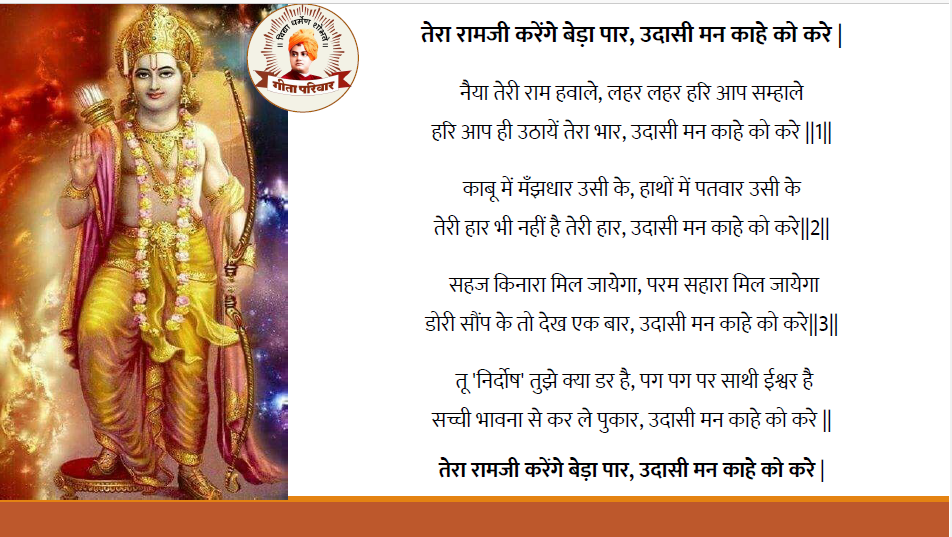
तेरा रामजी करेंगे बेड़ा पार, उदासी मन काहे को करे । (Your Ram will take you across the ocean, why does your sad mind worry?)
नैया तेरी राम हवाले, लहर लहर हरि आप संभाले (Your boat is entrusted to Ram, he himself will take care of the waves)
हरि आप ही उठावे तेरा भार, उदास मन काहे को करे ॥ (He himself will lift your burden, why does your sad mind worry?)
काबू में मझधार उसी के, हाथों में पतवार उसी के । (The midstream is under his control, the oar is in his hands)
तेरी हार भी नहीं है तेरी हार, उदासी मन काहे को करे ॥ (Your defeat is not your defeat, why does your sad mind worry?)
सहज किनारा मिल जायेगा, परम सहारा मिल जायेगा । (You will easily reach the shore, you will get the supreme support)
डोरी सौंप के तो देख एक बार, उदास मन काहे को करे (Just surrender the rope and see, why does your sad mind worry?)
तू निर्दोष तुझे क्या डर है, पग पग पर साथी ईश्वर है । (You are innocent, what are you afraid of, at every step God is your companion)
जरा भावना से कीजिये पुकार, उदास मन काहे को करे ॥ (Just call him with your feelings, why does your sad mind worry?)
The discourse ended with Hari Sankirtanam.
Question & Answer Session
Varsha ji
Question: Arjuna already knew with whom he had to fight even before the war. Why then did he get perplexed just before the war?
Answer: Arjuna knew that he will have to fight against Guru Dronacharya and Bhīṣma pitāmaha. But there is a difference between imagining and actual sight. It is like going to an examination. The actual fear arises only when one reaches the exam hall and sees the question paper.
Balchandar ji
Question: How to implement the following advice in real life?
मा कर्मफलहेतुर्भूर्मा ते सङ्गोऽस्त्वकर्मणि || 2.47 ||
You have a right to perform your prescribed duties, but you are not entitled to the fruits of your actions. Never consider yourself to be the cause of the results of your activities, nor be attached to inaction. Four aspects of this advice need to be followed:
- Do your duty, but do not concern yourself with the results
- The fruits of your actions are not for your enjoyment
- Even while working, give up the pride of doership
- Do not be attached to inaction

We are sure you enjoyed reading the Vivechan write- up. Please invest three minutes of your time to provide us your feedback. Use the link below:
https://vivechan.learngeeta.com/feedback/
Thank you-For reading the summary
You have enjoyed this vivechan writeup! In spite of intense editing and proofreading, errors of grammar, as also of omission and commission may have crept in. We appreciate your forbearance.
Jai Shri Krishna!
Compiled by: Geeta Pariwar – Creative Writing Department
Har Ghar Gītā, Har Kar Gītā !
Let’s come together with the motto of Geeta Pariwar, and gift our Geeta Classes to all our Family, friends & acquaintances
आओ गीता सीखें, विशुद्ध उच्चारण के साथ
Learn Geeta, Spread Geeta, Live Geeta
|| OM ŚRĪKṚṢṆĀRPAṆAMASTU ||