
विवेचन सारांश
Path of Devotion: Attain HIM through Love, Action, and Detachment
The 12th chapter of the Bhagavadgītā is Bhakti-Yoga - The Yoga of Devotion.
Today's session commenced with the lighting of the holy lamp followed by obeisance to Śrī Bhagavān and Gurudev.
In the grace of the divine, we are incredibly fortunate to have awakened to a life where we have dedicated ourselves to the redemption of our existence, the meaningful utilization of our lives, and the pursuit of the practice of the Bhagavadgītā. For centuries, numerous saints and wise beings have emphasized that there is no scripture more conducive to the welfare of human life than the Bhagavadgītā. Other texts either talk about well-being in this world or salvation in the afterlife. Many motivational speakers discuss prosperity in this world—how to boost your confidence, enhance your business, improve your behavior, and sweeten your speech, among other things.
However, when you read or listen to the Bhagavadgītā, it reveals the means for both worldly victory and eternal triumph in the hereafter. It is the only scripture that guides on how to be victorious in this world and sustain that victory in the next life. Even after this life, it delineates the nature of my redemption in future incarnations. Though small, it is incredibly powerful. The reason lies in the fact that while the Vedas are considered the exhalation of the divine, the Bhagavadgītā is the direct and spoken word of the divine. It emanates from the divine's lotus-like mouth. What can be better than that which directly comes from the source? Each verse of the Bhagavadgītā is filled with profound wisdom. Swamiji Maharaj states that those who regularly recite the Bhagavadgītā experience a transformation in their brain programming. Their physiological and psychological aspects undergo positive changes. Some proclaim that their diabetes has been alleviated, while others declare an improvement in their blood pressure. Numerous testimonials of the miraculous effects of the Bhagavadgītā are shared by individuals from diverse backgrounds.
Here, there is no intention to discuss miracles, but when these mantra-infused verses are recited with purity, real transformations occur in life. The Bhagavadgītā, a concise scripture of 700 verses, is a reservoir of wisdom. One verse is spoken by Dhritarashtra, 41 by Sanjaya, 84 by Arjuna, and the remaining 574 verses emanate directly from the divine lips of Sri Bhagavān. We are currently reflecting on Chapter 12, the shortest, simplest, and most benevolent among all chapters. It is believed that the most beneficial substance should be given to someone with limited time, hence the emphasis on studying Chapter 12.
Now, we begin our exploration of this chapter. This study is part of a long tradition. We examined ten verses in our previous session. Arjuna initially inquired about the suitable discipline for attaining divine knowledge, and Sri Bhagavān explained the paths of knowledge and devotion. Now, Arjuna seeks clarification on which of the two - knowledge or devotion - is superior. The discourse is initiated by Arjuna, and it is this initiation that brings forth the invaluable teachings from Lord Krishna's divine mouth. Why show me all the tablets in the chemist's shop? I only want the medicine prescribed by my doctor. Why bother with all the medicines in the shop?
In the previous session, in the last shloka (12.11), Sri Bhagavān told Arjuna:If taking recourse to the Yoga of My realization, you are unable even to do this, then, subduing your mind and intellect, etc., relinquish the fruit of all actions.
Now, the question may arise: How can one truly let go of attachment to the fruits of their actions? Picture a farmer sowing seeds. As those seeds blossom into trees, the farmer cannot selectively choose to sow seeds while rejecting the eventual trees. Such a stance is impractical. In this context, the guidance from enlightened beings is to detach from the results of actions rather than abandoning the actions themselves. This implies executing duties without being unduly influenced by the consequences—whether they unfold favorably, unfavorably, or neutrally. "I will dance with joy if the outcome aligns with my desires, and I won't be disheartened if it takes a different turn. I will fulfill my duties diligently, and regardless of the circumstances, I won't be excessively swayed."
Consider a bank cashier seated at his counter. If ₹2,00,000 arrives and not a single rupee more, does it alter his situation significantly? Likewise, we are all divinely appointed and assigned distinct roles. God has placed us in various roles - whether as a parent, employee, employer, player, or soldier. Simultaneously, we can navigate different roles with finesse. In each role, the essence lies in fulfilling our duties with a sense of responsibility, devoid of attachment to the outcomes. This encapsulates the crux of the teachings, and Sri Bhagavān emphasizes the praise for renouncing attachment to the fruits of actions in the 12th verse.
12.12
śreyo hi jñānamabhyāsāj, jñānāddhyānaṁ(v̐) viśiṣyate,
dhyānātkarmaphalatyāgaḥ(s), tyāgācchāntiranantaram.12.12.
Arjuna, immediate peace is found through renunciation. Bhagavān has conveyed profound insights here, emphasizing the superiority of knowledge attained through practice, even without delving into its intricacies. Contemplation on the universal form is deemed superior to mere knowledge, and renouncing the fruits of all actions through meditation is even more superior. This is because renunciation brings about instantaneous tranquility. Bhagavān states that knowledge is superior through practice.
In the sixth chapter, Bhagavān advocated the significance of practice.
However, one should not engage in mindless practice. The practice involves external senses—hands, feet, eyes, ears, and mouth. Since the practice is external, it appears straightforward. Saying, "There is a resolve not to go there" is simple. However, not even allowing thoughts about it is the real challenge. Let it be known that avoiding the mental image of a white elephant is not an easy task. Now, observe if everyone has a mental image of a white elephant. Controlling the mind proves to be challenging. Saying, "I won't do this" is straightforward. However, not even allowing thoughts about it is extremely challenging. It's a subtle matter, and the subtler it is, the more challenging it becomes. The practice involves the work of external senses; it may seem simple at the beginning, but it's a necessary step. Without practice, nothing significant can be achieved. However, through consistent practice, it becomes evident that knowledge holds superiority. Why? Because knowledge is the subject of intellect, and the intellect is subtle. Following this, meditation is deemed even superior to knowledge. Why? Because meditation involves the mind, which is subtler than the intellect. Therefore, meditation takes precedence over knowledge. Additionally, relinquishing the fruits of all actions through meditation is considered even more profound. To do so, one must renounce the ego, which is above the mind.
The divine asserts that true excellence resides not merely in practices but in the embodiment of virtuous qualities. The Bhagavadgītā has transcended into a universally revered scripture precisely because it does not endorse any exclusive path. Sri Bhagavān articulates, "The essence lies not in the direction of your journey; rather, it is paramount where you ultimately arrive." Sri Bhagavān underscores the profound importance of intrinsic attributes.
Consider a scenario akin to visiting a doctor and proclaiming, "Doctor, I have contracted malaria; prescribe me medication for malaria." Such an approach would leave the doctor dissatisfied, prompting inquiries about your symptoms. "What malady have you contracted? Why have you sought my assistance? Elaborate on your symptoms." Subsequently, after a thorough diagnosis, the doctor will determine whether you have malaria, a viral fever, or pneumonia.
Drawing a parallel, Sri Bhagavān in the Bhagavadgītā assumes the role of the supreme healer. Our conventional beliefs often revolve around practices such as applying tilak, maintaining a Shikha, donning the sacred thread, engaging in chanting, performing aarti, offering worship, and identifying ourselves as devout followers. Bhagavān states, "You may perceive yourself as a devotee according to your standards, but I withhold my approval."
In the face of potential uncertainty regarding approval, Sri Bhagavān asserts, "My endorsement follows a distinct classification with unique parameters. Singing and worshiping hold no significance; rather, the alterations in your nature post-engagement bear greater importance. I emphasize the transformative journey within your personality." Thus, across the Bhagavadgītā, Sri Bhagavān has curated a comprehensive checklist. Consider, in your self-assessment, what qualities define you; for it is through your attributes that the authenticity of your devotion is unveiled.
In the second chapter, Sri Bhagavān elucidates the characteristics of a steadfast individual. In the twelfth chapter, we will hear about the traits of a devotee. The13th chapter expounds on the characteristics of a knowledgeable person. In the fourteenth chapter, Sri Bhagavān delineates the attributes of one who transcends the qualities (guna-atita). The sixteenth chapter witnesses a transformation in the characteristics of divine and demonic natures, as described by Sri Bhagavān. All these chapters reveal symptoms.
Sri Bhagavān declares, "I am indifferent to the path you choose. It matters little to Me which deity you worship, or how you perform your rituals. However, when you engage in worship and devotion, certain symptoms manifest within you. What are these symptoms?" Bhagavān outlines 39 characteristics.
If you wish to identify as a devotee, do you exhibit some or all of these 39 indications / attributes?
Therefore, let us collectively examine our inner selves today. Let's assess the presence of symptoms within us. It's essential to understand that nothing is absolute; there is no complete 100 or zero. We need not be concerned if we don't find all 39 symptoms within us or if they don't add up to a full 100. However, the earnest endeavor should be to elevate what is at 10 to 15 within oneself. Strive to uplift what is at 18 to 22. Make a conscious effort to augment the range of symptoms from 40 to 50. If it's already at 50, strive to push it to 60. In simpler terms, the commitment is to progress beyond our current state. Upon deep contemplation of this approach, we will establish a connection with the symptoms.
Failing to adopt this perspective may lead us to believe that achieving these standards is beyond our reach, an unattainable goal. If we possess 25% and mistakenly assume it to be 100%, confusion will ensue. It is imperative to advance step by step from our current position. Sri Bhagavān assures, "I am offering you these parameters. You need not scrutinize others. I provide you with this stethoscope for self-examination. Evaluate your heartbeat, not that of others. The assessment of these 39 symptoms is meant for introspection within oneself, not for comparison with others."
Now, let's delve into the thirteenth and fourteenth verses together.
adveṣṭā sarvabhūtānāṁ(m), maitraḥ(kh) karuṇa eva ca,
nirmamo nirahaṅkāraḥ(s), ṣamaduḥkhasukhaḥ kṣamī. 12.13
santuṣṭaḥ(s) satataṁ(y̐) yogī, yatātmā dṛḍhaniścayaḥ,
mayyarpitamanobuddhiḥ(r), yo madbhaktaḥ(s) sa me priyaḥ.12.14.
Sri Bhagavān provides the checklist:
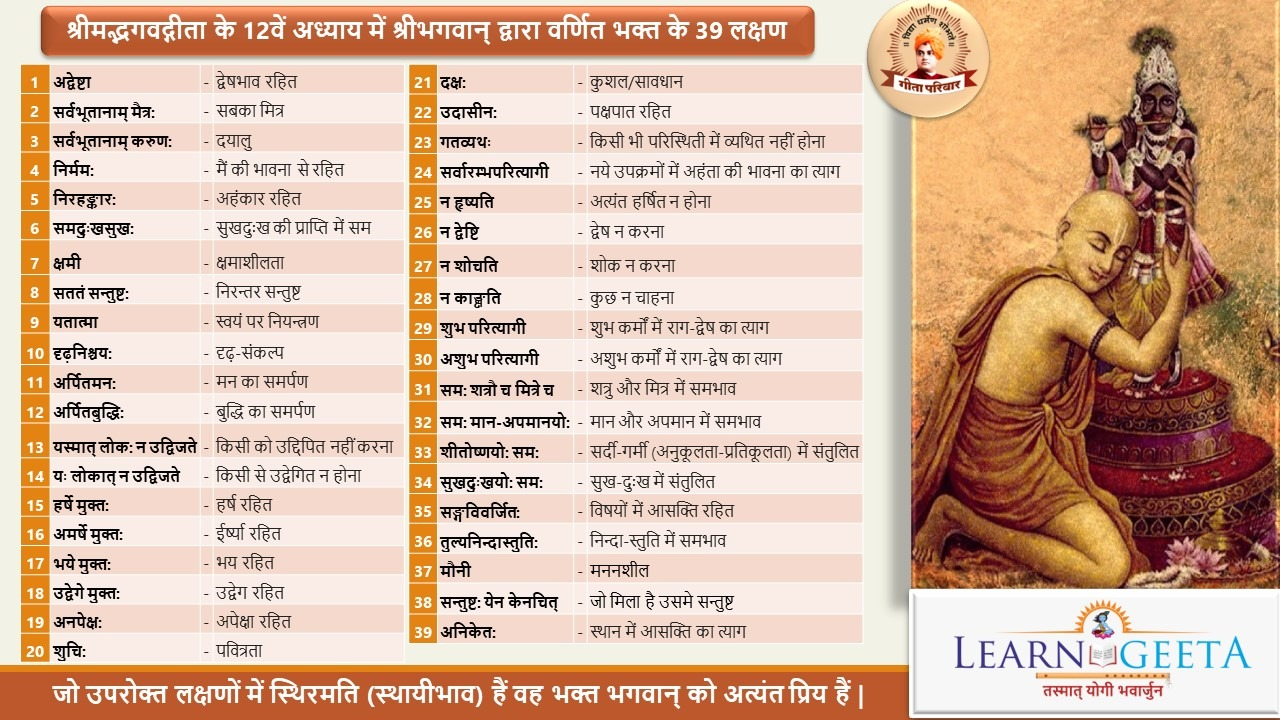
Expanding our endeavors is not an issue. However, attempting to diminish the efforts of others while striving to enhance our own is deemed as malice. In spiritual communities, numerous dedicated individuals tend to harbor animosity towards each other. They cultivate resentment, even in positive circumstances, questioning, "Why is this person making more progress than me?" Subsequently, they make endeavors to undermine the progress of others. Bhagavān cautions against such behavior, emphasizing that true devotion cannot coexist with malice. To embody devotion, one must refrain from harboring animosity towards anyone. Focus on personal advancement without obstructing the progress or diminishing the achievements of others.
Sarvabhūtānāṁ—Applicable to all living beings:
This principle extends beyond humans to encompass all living beings. Our culture embodies progressiveness. Sri Bhagavān instructs us to work for the well-being of all living beings, transcending the human realm. Taking responsibility for the welfare of a tree or a river is integral to this directive.
Maitraḥ—Friendly
Encountering conflicts with others is a common occurrence, often prompting us to utter, "Let it be. How long should we invest in trying to reconcile with them?"
Saint Rahim provides a unique perspective:
रूठे सुजन मनाइए, जो रूठे सौ बार।
रहिमन फिरि-फिर पोहिए, टूटे मुक्ताहार॥
"Convince the offended friend, even if they turn away a hundred times.
O Rahim, string the pearls again, for the broken necklace shines more."
In this couplet, Rahim underscores the importance of making persistent efforts to appease friends or family members, even if it requires a hundred attempts. He metaphorically compares the situation to a broken necklace, advising us to string the pearls back together repeatedly. The true value of these pearls becomes apparent when they are reconnected into the necklace.
An interesting facet lies in Rahim's choice of the term "Sujan", signifying virtuous or good-hearted individuals. This underscores the significance of reconciling with those who genuinely care for you, a rarity in today's world where finding individuals with sincere goodwill is a challenge. If such individuals exist in your life, it's essential not to let them remain distant. In the event of a strained relationship, persistent efforts should be made to reconcile and uphold a close connection.
"Sujan" encompasses three meanings: firstly, denoting close relatives or one's people, with whom a relationship exists. Such virtuous individuals warrant repeated efforts at persuasion. Secondly, "Sujan" can signify a virtuous person. If, for any reason, a good person becomes upset with you, every endeavor should be made to appease them. Thirdly, "Sujan" can extend to beloved ones, including a spouse, parents, or children. Continuous efforts should be undertaken to appease and maintain close ties with them.
Karuṇaḥ—Compassionate
The Patanjali Yoga Sutras delineate four pathways to attain mental purity:
• Cultivate Friendship (Maitrī) with those experiencing happiness.
• Embrace Compassion (Karuṇā) for those in sorrow.
• Experience Joy (Muditā) for the virtuous and meritorious.
• Maintain Indifference (Upekṣā) towards those engaged in wrongdoing.
In the Bhagavadgītā, Sri Bhagavān elaborates on these principles, urging the cultivation of camaraderie with the joyful and virtuous, alongside extending compassion to those undergoing hardship or involved in wrongful actions.
A nuanced distinction emerges between karuṇā (compassion) and dayā (mercy). Karuṇā radiates expansively from the heart, encompassing all. Dayā, in contrast, is situation-specific and may carry a subtle sense of superiority, manifesting as "I extend compassion to others." Karuṇā involves absorbing the suffering of others into our own being, prompting questions like, "Why subject them to such pain? What causes their distress?" Compassionate saints naturally embody the spirit of karuṇā.
To surmount the suffering and wrongdoing of others, one must nurture karuṇā. This entails a profound understanding and internalization of the pain and misery experienced by others. While dayā is a noble quality limited to the powerful—kings, authorities, and wealthy individuals, karuṇā is a virtue accessible to every human being, transcending the need for special capabilities.
Attachment to both possessions and individuals emerges from the notion of ownership—this belongs to me, that is mine. Whether it's my son, bank balance, factory, or mobile phone, such expressions encapsulate possessiveness, leading to distress.
Once, a couple ventured out to purchase a refrigerator. Assisted by a salesperson, they explored various models. Upon selecting a specific refrigerator, the salesperson proposed, "Let's proceed with the billing. We'll attach a tag with your name to this fridge to ensure no one else claims it. Initially, all the pieces are identical." The salesperson labeled it as "Mr. and Mrs. Gupta." During the billing process, two employees carrying another fridge walked by. Mr. Gupta, concerned, exclaimed, "Be cautious! Don't let it touch my fridge. I haven't completed the payment. The billing process is still underway." However, the moment the tag with "Mr. and Mrs. Gupta" was affixed to the fridge, a sense of ownership materialized. Now that it was deemed 'mine,' apathy extended towards other fridges. Regardless of potential damage to them, it didn't matter; however, any harm to 'his' fridge induced distress. The genesis of suffering lies in the germination of possessiveness.
In the absence of a sense of possession, worry and sorrow are absent. Possessiveness is the root cause of all suffering. We project ourselves as intelligent, powerful, degree holders, doctors, geniuses, and prolific writers, and affix numerous labels to our identity. The more tags we attach, the deeper we submerge ourselves, heightening our vulnerability to distress.
God states that those who become devoted to Him attain liberation from the ego.
Pathik Ji's poignant bhajan underscores:
मैं नहीं, मेरा नहीं, यह तन किसी का है दिया ।
जो भी अपने पास है, वह सब किसी का है दिया ॥
"It's not mine, it's not me—this body is bestowed upon someone.
Whatever one possesses belongs to everyone else."
In our lives, the prominence of 'I' and 'My' correlates with the diminishing scale of our devotion.
Nirahankāraḥ—Free from Egoism
Sama—Equipoised
Maintaining equanimity in the face of joy and sorrow is not solely a matter of restraint; nevertheless, one can mitigate its impact. Upon experiencing something joyful, individuals promptly update their status. Observing those who have viewed the status, liked it, and commented on it becomes a natural response. Expressing appreciation to those who comment with a "Thank you" is common. The individual is now approaching the end of their life, having established a store of sorrow. Those who excessively revel in joy will inevitably face an equivalent measure of suffering when sorrow befalls them. Therefore, whether joy or sorrow arises, delving too deeply into its essence is unwise. The duration of its presence should not be unduly prolonged. Allow it to linger for a while and then let it fade away. If sorrow persists for two days due to a circumstance, bring it to attention for only one day. If sorrow persists for one day, address it for half a day. This practice will foster the development of a devotional disposition.
kṣhamī—forgiving
Forgiveness is a virtue that everyone needs, but no one wants to give. If we make a mistake, we expect everyone to forgive us. But what if someone else makes a mistake? How many times should we forgive them? We are tired of forgiving over and over!
We don’t even remember whom we forgave. That is true forgiveness. If we keep it in our mind after forgiving, I forgave this person. Then what did we do? We are holding on to it! And if we get a chance, we will dig up the old grudges. You did this three years ago, I didn’t say anything then, but now it comes back with interest. And it comes back louder. If it comes back after three years, it comes back with more force. Forgiveness should be natural. We did it and forgot about it. The other person is grateful that you forgave them and you don’t even remember, that is true forgiveness.
You must have heard the name of Maharaja Ranjit Singh. Once he was riding. People were lined up and watching. Suddenly a stone hit his head. And blood started flowing. There was panic. The soldiers found out that a child had a stone in his hand, meaning he had thrown the stone. They brought him. Ranjit Singh said, wait, ask him what the matter is first. The boy was scared, he was trembling. Ranjit Singh asked the boy, did you throw this stone? The boy said, yes, I was plucking mangoes, I missed the target and it hit you. I didn’t know you were passing by. It was my mistake, he started crying. Ranjit Singh smiled. He ordered the commander to send six crates of mangoes to his house. Ranjit Singh said something that is an important message for all of us. He said this mango tree gives mangoes even after being hit by stones. It hit me unknowingly. Am I worse than that mango tree? He should be sent six crates of mangoes right away. This is forgiveness! To see the faults of others as small. This will make your life very happy. Peace will come in life.
santuṣhṭaḥ—content
गो-धन, गज-धन, वाजि-धन और रतन-धन खान।
जब आवत संतोष-धन, सब धन धूरि समान
Wealth in the form of cows, elephants, horses, and precious gems—consume them.
When the richness of contentment enters one's life, all other forms of wealth pale in comparison.
Even if an individual possesses the riches of a cow, an elephant, a horse, and a treasure trove of gems, true contentment eludes them. When the treasure of contentment graces their life, all other wealth becomes as inconsequential as dust or dirt. In essence, contentment stands as the paramount treasure.
An Italian tale known as "The Happy Man's Shirt" narrates the story of a king on a quest to find a happy man's shirt to save his son's life. Ultimately, he discovers that a genuinely content man wears no shirt.
In the Mahabharata, a Yaksha posed 100 questions to Yudhishthira Maharaj. Among them was the query, "Who is poor?"
Yudhishthira Maharaj responded, "One who harbors discontent is poor." Therefore, in gratitude for whatever God has bestowed upon us, our endeavor should be to embrace contentment.
सीता राम सीता राम,
सीताराम कहिये,
जाहि विधि राखे राम,
ताहि विधि रहिये।
Sita Ram, Sita Ram,
Chant Sita Ram,
Live by the divine will of Ram,
Thus, abide by the path of righteousness.
satatam—steadily; yogī—united in devotion; yata-ātmā—self-controlled
Many of us tend to be quite proud. Expressing their pride, they often say, "I cannot tolerate this. Everything else is fine, but I cannot bear this." Well, that's not a positive attitude.
A true devotee should be capable of enduring anything. Whatever I desire, I can do. There should be complete control over the restlessness of the mind, intellect, consciousness, and senses.
It is essential to cultivate a sense of humility and understand that pride can hinder spiritual growth. Instead of saying, "I cannot tolerate this," a more positive approach is to say, "I can handle anything with the strength derived from my devotion."
A yogi, constantly united in devotion and possessing self-control, can navigate through life's challenges with equanimity. The ability to endure, coupled with a steady and devoted mindset, leads to a harmonious and balanced existence.
dṛiḍha-niśhchayaḥ—firm resolve
A true devotee should possess unwavering determination. Once a commitment is made, it must endure without faltering.
In the tale of Parvati, guided by the words of Naradji, she embarks on a rigorous penance to attain Lord Shiva. The seven sages arrive to test her dedication. Parvati resolutely proclaims, "I am prepared to undergo a thousand lifetimes of penance if necessary, but my heart will only accept Shiva as my eternal consort."
This narrative vividly illustrates firm resolve. God holds in high regard those devotees who surrender their mind and intellect to Him. Such devotees are cherished by the Divine.
In the Aranya Kanda (Ramayana), the story of Sage Sutikshna unfolds.
नहिं सतसंग जोग जप जागा।
नहिं दृढ़ चरन कमल अनुरागा॥
एक बानि करुनानिधान की।
सो प्रिय जाकें गति न आन की
"Without the company of truth-seekers, devoid of meditation, and lacking perpetual vigilance on the righteous path,
Without an unwavering devotion to the Divine's lotus feet,
No progress is made toward attaining the cherished goal."
Sri Bhagavān Himself descends to grant a vision to Sage Sutikshna. Shifting His course to prioritize meeting Shabri Ji, the Divine adjusts His path. Upon arriving to bestow a vision upon Sage Sutikshna, the sage is deeply absorbed in meditation, wearing a serene smile while focusing on the contemplation of Śrī Rama. Sri Bhagavān playfully calls out, "If your eyes open, you will behold Me." However, Sutikshna, profoundly immersed, keeps his eyes closed. Sri Bhagavān attempts again, but Sutikshna remains lost in meditation. Delightfully, Sri Bhagavān then withdraws the vision that Sutikshna was beholding. Sutikshna's eyes open abruptly, and he wonders, "Where did Bhagavān go?" Witnessing this, Sri Bhagavān is amused and imparts profound teachings to Sutikshna on applying wisdom to perceive the Divine presence.
होइहैं सुफल आजु मम लोचन।
देखि बदन पंकज भव मोचन॥
निर्भर प्रेम मगन मुनि ग्यानी।
कहि न जाइ सो दसा भवानी
Behold the Divine's lotus feet, the liberator from worldly attachments.
The wise sage, steeped in boundless love,
Should never relinquish this divine experience."
yasmānnodvijate loko, lokānnodvijate ca yaḥ,
harṣāmarṣabhayodvegaiḥ(r), mukto yaḥ(s) sa ca me priyaḥ 12.15
"I should avoid causing trouble, and if trouble comes my way, maintaining composure is a significant challenge. Noble individuals naturally refrain from troubling others. According to God, both aspects are essential."
Bhartrihari’s Niti Shatak:
मृगामिनं सज्जनं प्राणसन्तोषवर्धनम् ।
तृणजलसन्तोषवित्तिनं लुब्धधीरर्पितक्षुधम् ॥
निष्कारणवैरिणो जगति दृश्यन्ते चत्वार एव ।
विद्वान् विशेषज्ञः कविरथवा दुर्जनः प्रायशः ॥78॥
"Wise individuals find contentment in life like a free deer in the forest. Experts find contentment in the simplicity of a blade of grass and water. Poets find contentment in the intellectual hunger they cultivate. The wicked, without reason, remain hostile."
To be undisturbed is a mark of excellence. How to achieve this? The solution is explored in this beautiful bhajan:

"With Lord Raghunath by our side, what worry is there?
Surrendered at His feet, what concern remains?
Day and night, what baseless worries trouble you?
Your Lord takes care of every concern." (Verse 1)
"With Lord Raghunath by our side, what worry is there?
Not concerned about eating, drinking, dying, or living,
With every breath, only the beloved name of God is the focus." (Verse 2)
"With Lord Raghunath by our side, what worry is there?
Vibhishana received the boon of fearlessness,
Chanting virtues, why worry about the opinions of enemies?" (Verse 3)
"With Lord Raghunath by our side, what worry is there?
The devotee, blessed by His grace, becomes His servant,
Now, in His hands, what remains to worry about?" (Verse 4)
"With Lord Raghunath by our side, what worry is there?
Surrendered at His feet, what concern remains?
What worry is there? Oh, what worry is there?" (Verse 5)
There is no concern for those who identify with Śrī Raghunath ji , Śrī Krishna, or Shiv ji. Raghunath ji, Bhagavān Śrī Krishna, Bhagavān śiva—they are with us, so what is there to worry about?
In this context, Sri Bhagavān speaks of four qualities devotees should embody for freedom: joy, indifference, fear, and agitation. Joy, meaning not overly excited; a little inconvenience should not lead to excessive reactions: indifference, the ability to tolerate varying conditions. Agitation should be absent; strength is needed to endure life's dualities. Become a bit strong in facing favorable and unfavorable conditions. Sometimes, if the light goes out, turn off the fan and sit for a while. If hungry, delay eating a bit, ensuring resilience in food scarcity. This is the path for those aspiring to be devotees—bring strength into life for endurance. Acceptance, opposition, cold, heat—develop strength in facing life's dualities.
napekṣaḥ(ś) śucirdakṣa, udāsīno gatavyathaḥ,
sarvārambhaparityāgī, yo madbhaktaḥ(s) sa me priyaḥ. 12.16
"anapekṣhaḥ—indifferent to worldly gain
The root cause of all miseries in Samsara lies in expectations. It is not the behavior of others but the expectations from them that lead to misery. Understanding that the desires of others are the source of suffering is crucial. Most family disputes arise due to unrealistic expectations ('apekṣhaḥ'). A true devotee is liberated from these expectations.
śhuchiḥ—pure
Sri Bhagavān emphasizes that a devotee's life should be pure. Purity extends to both external and internal aspects of life. In our devotional practices, there is a mantra:
।। देवो भूत्वा देवं यजेत् ।।
It signifies worshiping the deity as a divine being. Deities do not accept worship without purity and sincerity. Many people mistakenly believe, 'I performed extensive worship, yet I didn't receive the expected benefits. Surely, the deity isn't real.' This perspective fails to grasp that deities expect us to approach them with sincerity, not bargaining for rewards. Therefore, worship should be undertaken with reverence and a pure heart.
Internal purity encompasses the cleanliness of thoughts, desires, motives, and feelings towards others, devoid of deceit and hypocrisy. This purity is the true adornment of a devotee's life.
dakṣhaḥ—skillful
Approximately 30 years ago, each door in Geeta Bhavan in Haridwar had a plate with "Savadhan" written on it. Shetaji Goyandaka ji, the founder of Geeta Press and the creator of Geeta Bhavan, stressed the importance of being attentive at all times. This reminder aimed to prevent seekers from making mistakes in their devotion. Being alert constantly is the nature of a true devotee. The goal is to avoid falling short in devotion, ensuring that Bhagavan remains pleased for any reason."
A brief narrative involving three businessmen, serving as an illustrative example of the importance of attentiveness: These entrepreneurs convened at a small village dormitory after completing their day's work. While two of them had brought their lunch boxes, the third arrived without one. Generously, the two with lunch offered to share their food, opting to combine their meals and distribute them equally. One businessman had brought 5 rotis, while the other had 3. The total of 8 chapatis was divided into 24 pieces, ensuring each of them received 8 pieces. To the astonishment of the two who shared their lunch, the next morning, the third person had vanished, leaving behind 8 gold bars.
The ensuing dispute centered on how to allocate the gold bars between them—whether it should be a 4-4 split or a 5-3 division based on the number of rotis contributed. Unable to resolve the disagreement, the dormitory manager suggested seeking the assistance of the wisest person in the village, renowned for delivering just decisions in disputes. The wise man agreed to intervene only if both parties pledged to abide by his decision, a commitment they willingly made, expecting an equitable 4-4 or 5-5 distribution.
The delivered verdict shocked everyone. The businessman who contributed 5 chapatis received 7 gold bars, while the one with 3 chapatis received only 1 gold bar. The wise man explained the logic behind this decision, clarifying that the person with 5 chapatis (15 pieces) contributed 7 pieces to others after retaining his share of 8. On the other hand, the individual with 3 chapatis (9 pieces) contributed only 1 piece to others after taking his share of 8. Thus, the distribution of gold bars aligned with their respective contributions, resulting in a 7-1 split. While challenging to grasp through ordinary thinking, everyone acknowledged the fairness of the verdict.
This story serves as a reminder that comprehending the messages of great souls, as found in scriptures, can be difficult initially due to our ordinary mindset. A person who is alert and attentive possesses fine discrimination, elevating their thinking beyond the ordinary. When encountering the extraordinary in the lives of great souls, it's essential to recognize the limitations of our comprehension.
udāsīnaḥ— The term "udāsīnaḥ," a fusion of "ud" and "āsīnaḥ," symbolizes one positioned on a higher pedestal. This elevated stance of a judge facilitates impartial observation of those under trial. It is imperative to clarify that "udāsīnaḥ" doesn't denote a state of depression; rather, Sri Bhagavān encourages a disposition of joy rather than gloom.
Devotees, embodying this sense of detachment, rise above the complexities of the world (Samsara), enabling unhindered worship of Sri Bhagavān. This state epitomizes those who have reached the zenith of the Bhakti path.
gata-vyathaḥ— Defined as one untroubled, "gata-vyathaḥ" characterizes an individual undisturbed by the frequent challenges presented by Samsara. In stark contrast to common experiences where people easily succumb to minor inconveniences, sincere devotees remain serene even amid severe trials. They do not yield to the impact of others' ill behaviors or lament over material losses.
sarva-ārambha—parityāgī— These are the distinctive traits of a Bhakta who has attained the culminating stage of Bhakti Yoga. Initially, seeking refuge in auspicious activities becomes crucial to counteract the effects of inauspicious ones, analogous to using one thorn to remove another. Progressing further, a genuine devotee enters a stage where both inauspicious and auspicious activities are renounced. Engagement in activities, such as those offered by Geeta Pariwar, safeguards time from potential misuse on distracting platforms. Beginners on the path of devotion should concentrate on such auspicious pursuits to ward off negativity.
At the ultimate stage, mirroring the act of discarding both thorns after removing the first, the adept relinquishes both inauspicious and auspicious activities. Yogis of high stature refrain from initiating new actions, yet conscientiously fulfill any responsibilities that come their way.
yo na hṛṣyati na dveṣṭi, na śocati na kāṅkṣati,
śubhāśubhaparityāgī, bhaktimānyaḥ(s) sa me priyaḥ. 12.17
It's a common observation that some individuals linger in grief for an extended period after losing close relatives. It seems as though they have momentarily forgotten the universal truth that everyone must eventually depart from this world. Similarly, certain people form emotional attachments to material possessions, retaining vivid memories of even minor losses or thefts for years. In contrast, those endowed with wisdom understand the transitory nature of life and refrain from protracted grieving.
A devotee who has attained complete devotion reaches a state where they can willingly renounce both virtuous and malevolent actions. However, until achieving this advanced stage, one must persist in performing good Karma (actions) to counterbalance the effects of past or present negative actions, whether committed by oneself or others.
Devotees embody contentment in their lives by eschewing the desire to accumulate more than what is truly essential. They find fulfillment in what they possess, viewing it as a divine gift from Sri Bhagavān. This perspective shapes their approach to material wealth and possessions.
Individuals exhibiting all the described characteristics are regarded as truly devoted, holding a special place in the affection of Sri Bhagavān. Their ability to navigate life with wisdom, detachment, and contentment makes them particularly dear to the Divine.
ṣamaḥ(ś) śatrau ca mitre ca, tathā mānāpamānayoḥ,
śītoṣṇasukhaduḥkheṣu, ṣamaḥ(s) saṅgavivarjitaḥ. 12.18
For beginners on the path of devotion, it is crucial to recognize that we cannot control the opinions others hold about us. It's advisable not to harbor enmity towards others, regardless of whether they reciprocate such feelings. Adopting the perspective that if someone doesn't like us, it's their problem and not ours can be a liberating mindset. Shishupal and many others harbored enmity against Sri Krishna—how insignificant are our grievances in comparison?
Equanimity towards both friend and foe entails not experiencing excessive joy upon meeting a friend or profound agitation upon encountering a foe. Sri Bhagavān advises against harboring hostility towards anyone, even foes. While physical pain resulting from accidents may be beyond our control, the mental distress associated with such incidents lies within our realm of influence. Individuals exhibit varying responses to adversity, some fulfilling their duties with a 101 F fever, while others delegate responsibilities even with a 90 F fever.
मन के हारे हार है मन के जीते जीत ।
कहे कबीर हरि पाइए मन ही की परतीत ।
The verse by Kabir emphasizes that victory and defeat in life are determined by the state of one's mind. If an individual succumbs to despair and defeat in their mind, they experience failure. Conversely, those who triumph over their mental challenges emerge as victors. The verse underscores the significance of trust and confidence in achieving success, even in attaining the divine.
During the Corona pandemic, many did not succumb to the virus itself; rather, they fell victim to the battles within their minds. Those with resilient minds triumphed over the challenges posed by Corona, even at an advanced age. The strength of one's mind plays a pivotal role in determining the outcome of the battle for life.
tulyanindāstutirmaunī, santuṣṭo yena kenacit,
aniketaḥ(s) sthiRāmatiḥ(r), bhaktimānme priyo naraḥ. 12.19
चाहे करे निन्दा कोई, चाहे कोई गुणगान करे,
फूलों से सत्कार करे, काँटों की चिन्ता न करे,
मान और अपमान ही दोनों, जिसके लिये समान रे
वह सच्चा इंसान रे, वह सच्चा इंसान रे
One may face either praise or reproach in life, determined by destiny. Sometimes, abundant praise is received without significant effort, often attributed to past virtuous deeds. Conversely, one may face unwarranted criticism even in the absence of any wrongdoing. Therefore, when receiving either praise or reproach, it is advised to treat them with equanimity.
Sri Bhagavān elucidates another hallmark of a true devotee—unconditional contentment. Such a devotee remains perpetually satisfied with what is, showcasing unwavering contentment.
Aniketaḥ - without attachment to the place of residence
Some individuals develop unwarranted attachments to specific seating positions, even in public or within their homes, hindering the path of Bhakti Yoga. A genuine devotee relinquishes such attachments and maintains equanimity regarding their place of stay.
Sri Bhagavān concludes the enumeration of the 39 symptoms of a full devotee (Bhakta). He underscores the importance of keenly observing these symptoms, emphasizing their firm and unwavering presence in the devotee's character. While beginners may identify some of these qualities within themselves, the key is whether these traits remain steadfast. Sri Bhagavān emphasizes that devotees with a firm commitment to these 39 symptoms are particularly dear to Him.
True devotees consistently strive to engage in actions that bring pleasure to Sri Bhagavān. They endeavor to embody all 39 qualities cherished by Sri Bhagavān. The story of Hanumanji illustrates this commitment. In his quest to please Sri Rama, Hanumanji inquires why Sita Mata adorns herself with Sindur. Her response, stating that it pleases Sri Rama, inspires Hanumanji to apply Sindur and Ghee to his entire body. Additionally, he receives a boon from Sita Mata, ensuring that anyone who applies Sindur and Ghee to Hanumanji will also become dear to Sri Rama.
ye tu dharmyāmṛtamidaṁ(y̐), yathoktaṁ(m) paryupāsate,
śraddadhānā matparamā, bhaktāste'tīva me priyāḥa.12.20.
Devotees who wholeheartedly surrender to Sri Bhagavān and consider Him as the supreme goal become exceedingly dear to Him.
The discourse ended with Hari Sankirtanam.
om tatsaditi śrīmadbhagavadgītāsu upaniṣatsu
brahmavidyāyāṃ(y̐) yogaśāstre śrīkṛṣṇārjunasaṃvāde
bhaktiyogo nāma dvādaśo'dhyāyaḥ.

We are sure you enjoyed reading the Vivechan write- up. Please invest three minutes of your time to provide us your feedback. Use the link below:
https://vivechan.learngeeta.com/feedback/
Thank you-For reading the summary
You have enjoyed this vivechan writeup! In spite of intense editing and proofreading, errors of grammar, as also of omission and commission may have crept in. We appreciate your forbearance.
Jai Shri Krishna!
Compiled by: Geeta Pariwar – Creative Writing Department
Har Ghar Gītā, Har Kar Gītā !
Let’s come together with the motto of Geeta Pariwar, and gift our Geeta Classes to all our Family, friends & acquaintances
आओ गीता सीखें, विशुद्ध उच्चारण के साथ
Learn Geeta, Spread Geeta, Live Geeta
|| OM ŚRĪKṚṢṆĀRPAṆAMASTU ||