
विवेचन सारांश
The Divine Secret : Cutting the Tree of Bondage
It's an atmosphere filled with immense joy, enthusiasm, and happiness. Today, there is the opportunity to contemplate from such a blessed land, a land that is considered the most important pilgrimage site by the saints of Maharashtra, Alandi, which is the Samādhi place of Sant Śrī Dyaneshwar Maharaj. People have gathered at that place to celebrate the festival of devotion to the Gītā, which coincides with the 75th birthday of the revered, venerable Swamiji Maharaj, Govind Dev Giri Ji Maharaj. Pujya Swamiji doesn't celebrate his birthday. He never lets anyone celebrate it either. This time, due to the grace of Pujya Swamiji, we are allowed to combine the birthday celebration with the Gītā Bhakti Amrut Mahotsav.
From all over the country, many respected saints are participating in this nectar festival. Remarkable work is being done. Eighty-one Kund rituals are taking place here. Such rituals, which are rare to witness, and whose mention we only find in scriptures, and ancient texts, are now being manifested. It's because there are very few Vedic scholars left who perform such rituals.
Through the Vedavyas Pratishthan medium, in the past 37-38 years, more than 2000 Vedic scholars who have memorized the Vedas have been trained throughout the country. These Vedic scholars, who have memorized at least one Veda, will offer oblations in the 81 Kund ritual. These are rare sights. The recitation of 51 specific scriptures will take place. It's filled with incredible events. These events feel like a grand festival.
Today, from the land of Saint Jnaneshwar, we contemplate the discussion of the 15th chapter of the Bhagavadgītā. This is an extremely special blessing for all of us. Among all the commentaries on the Bhagavadgītā, Jnaneshwari Mukutamani stands out. In the 16th century, Saint Jnaneshwar elaborated on the Bhagavadgītā in the form of a commentary in ten thousand verses.
We are exploring the discourse of the Purushottam Yoga in the 15th chapter. Sri Bhagavān presented the concept of this world through the analogy of the upside-down peepal tree in the first and second verses. Through this imagery, Sri Bhagavān depicted the nature of the cosmos. In the third verse, Sri Bhagavān also advises us not to get confused.
Sri Bhagavān explains, "The tree you have imagined has a beginning and an end. It's simply an illustration. However, MY universe knows no beginning or end, possesses no definable shape, and is boundless." HE then expounds upon the state of one who comprehends this concept. We have pondered over this in the previous session.
In the 6th verse, Bhagavan is introducing HIS abode.
15.6
na tadbhāsayate sūryo, na śaśāṅko na pāVākaḥ,
yadgatvā na nivartante, taddhāma paRāmaṃ(m) mama. 15.6
Sri Bhagavān assures Arjuna, "Those who enter MY abode never return to this world."
We continue cycling through birth and death for countless years. Our actions in this life determine our next birth, subjecting us to the trials of Samsara.
This Samsara, known as
दुःखालयं शाश्वतं लोका
(Dukhālayam śāśvatam lokaḥ), is a realm of suffering and impermanence. While one may temporarily enjoy wealth and success, the inevitable challenges of life often lead to disillusionment with worldly pursuits. In times of distress, individuals seek solace in prayer, longing for liberation from the relentless cycle of Samsara.
They question the duration of their suffering and yearn for a way out.
The only way one can achieve liberation is by attaining HIS abode, from where there is no return.
Sri Bhagavān emphasizes that those who attain HIM transcend the cycle of birth and death.
Sri Bhagavān says that the radiance of HIS abode surpasses even that of fire, the moon, and the sun. It is the divine realm of Bhagavān HIMSELF. Once one reaches there, one is free from this quagmire of endless births..
Sri Bhagavān elucidates on the nature of the soul in the next verse.
mamaivāṃśo jīvaloke, jīvabhūtaḥ(s) sanātanaḥ,
manaḥ(ṣ) ṣaṣṭhānīndriyāṇi, prakṛtisthāni karṣati. 15.7
There is a distinction between Sanatan (eternal or timeless) and Puratan (ancient). Sanatan signifies eternity, always existing without a beginning or an end. It has been there forever, and it will continue forever. Sri Bhagavān declares:
"तत् त्वम् असि"
(That thou art) - You are not different from ME.
After all, a drop of water from the sea and the sea itself are not distinct; yet the drop is not called the sea. It is only when the drop merges with the sea that it can be identified with this vast body of water.
Similarly, the individual soul (Jivatma) is a part of the Supreme Soul (Paramatma). However, until we recognize our true nature, we continue to wander. In Vedanta, there is a theory - all is one. So why then the distinction? Sometimes we question, "If we are all part of God, where do good and evil come from? Where do demons come from? Where does the tendency to commit sinful acts originate? Why do we lie? Why do we commit sins? Why do such wicked individuals exist?" For this, Vedanta provides an analogy.
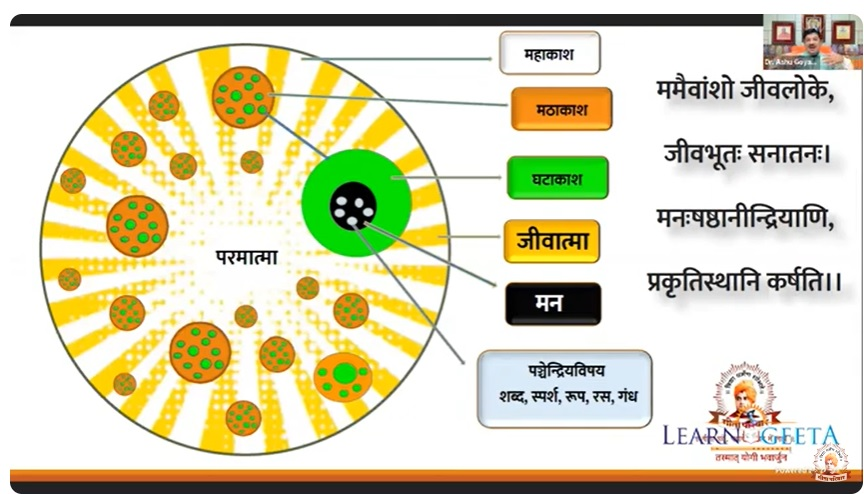
Matakash: Though ether is the same the properties are different in different environments. Similarly, Paramātmā is one and the same but appears different. The ether outside and in the pot is the same. If the pot is broken does the ether merge with the environment? It is always and same and remains the same.
Ghatakash: The Jeevatma and mind are within the GhaTakash along with the five senses (speech, touch, form, taste, and fragrance), five organs of action, and five jnanendriyas.
The above three may seem different externally but the innate nature is the same. For further elaboration on these concepts, let us delve deeper into the nature of Paramātmā and HIS sway over space.
Although the space surrounding us may seem different outside and inside the house, it is the same. Even the space within a small glass, which may have different characteristics like temperature, is identical to the space surrounding us.
Similarly, Paramatma, the Supreme Self, can be likened to Mahakash, the great space. Within this Mahakash, it manifests as Mathakash, the cosmic space, and further condenses into Ghatakash, the space within the body of living beings containing the essence of consciousness (Chetan tattva). The Jivatma, the individual soul, is drawn into the cycle of Samsara due to the influence of the mind and the five senses.
The Vedantic theory that addresses Paramatma, Jīvātmā, Mahakash, Mathakash, Ghatakash, Mind, and the five senses is grounded in the concept of Panchikarana, the five-fold division and combination of the elements. According to this theory, there are five elements: Akasha (space), Vayu (air), Agni (fire), Jala (water), and Prithvi (earth). These elements are the manifestations of Maya and serve as the fundamental constituents of the universe.
Paramatma, as the Supreme Self, transcends the gross, subtle, and causal realms. It is the originator, sustainer, and dissolver of all worlds. Parmatma is the ultimate controller, enjoyer, and liberator of all individual selves. It encompasses the knower, the known, and the knowledge of all phenomena. Parmatma is singular, infinite, eternal, and imbued with bliss.
This verse explains the relationship between Parmatma, Jīvātmā, Mahakash, Mathakash, Ghatakash, Mind, and the five senses. The verse states that:
"ममैवांशः"
(mamaivāṃśo): Jīvātmā is the fragmental part of Parmatma, meaning that Jīvātmā is essentially the same as Parmatma, but appears as different due to the influence of Maya. It signifies the eternal relationship between the individual soul and the Supreme Soul.
"जीवभूतः सनातनः"
( jīvabhūtaḥ sanātanaḥ): Here, the eternal nature of the individual soul is emphasized, which correlates with the concept of Sanatan, meaning eternal. Jīvātmā is eternal, meaning that Jīvātmā is not created or destroyed, but exists eternally as the conscious principle of life.
"मनःषष्ठानीन्द्रियाणि"
(manaḥ ṣaṣṭhānīndriyāṇi): This part refers to the mind and the six senses (the five senses plus the mind), which are the instruments through which the individual soul interacts with the external world. Jīvātmā is struggling with the six senses, meaning that Jīvātmā is afflicted by the dualities of pleasure
and pain, heat and cold, honor and dishonor, etc., which are the results of the contact of the senses with the objects. The six senses include the mind, meaning that the mind is also a sense organ, which perceives the subtle objects of thoughts, feelings, emotions, etc. The six senses are situated in material nature, meaning that the senses are also the products of the material nature or Prakriti, and are subject to the modes of goodness, passion, and ignorance.
"प्रकृतिस्थानि कर्षति"
(prakṛtisthāni karṣati): This part refers to the individual soul being influenced by the material nature (Prakṛti) and experiencing the fruits of its actions. It suggests that the individual soul, due to its association with the material world, is pulled by the qualities of nature. Jīvātmā is situated in the material world, meaning that Jīvātmā is bound by the gross, subtle, and causal bodies, which are the products of the material nature or Prakriti.
śarīraṃ(y̐) yadavāpnoti, yaccāpyutkrāmatīśvaraḥ,
gṛhītvaitāni saṃyāti, vāyurgandhānivāśayāt.15.8
The verse describes the transmigration of the embodied soul, comparing it to the movement of fragrance carried by the wind. Just as the air temporarily holds fragrance without being affected by it, the Jivatma, the conscious essence within, carries the mind and senses from one body to another during the transition from an old body to a new one.
Sri Bhagavan illustrates this phenomenon by likening the Jivatma to the air that carries fragrance. The Jivatma, imbued with consciousness, transports the inert elements of mind and senses. Despite carrying the impressions of countless births and the karmic consequences of past actions, represented by Pap (sin) or Punya (virtue), the Jivatma remains unaffected, akin to the air untouched by the fragrance it carries. It remains detached, embodying the essence of Nirlep Narayana.
The transient vessel of the body undergoes continuous change and eventual dissolution. Yet, the Jivatma persists, carrying the aspirations, desires, and cravings from one incarnation to the next, seeking fulfillment in its journey through existence.
śrotraṃ(ñ) cakṣuḥ(s) sparśanaṃ(ñ) ca, rasanaṃ(ṅ) ghrāṇameva ca,
adhiṣṭhāya manaścāyaṃ(v̐), viṣayānupasevate.15.9
The verse highlights the role of the five senses—ears, eyes, skin, tongue, and nose—in experiencing the world. The embodied soul utilizes these senses, clustered around the mind, to engage with sensory objects.
1. Ears
श्रोत्रं
The ear, the primary organ for hearing, holds significant importance. Even after death, it remains active for about six hours, emphasizing its crucial role. However, becoming attached to any sense organ can be perilous, as illustrated by the tale of the Kasturi Mriga. This deer, typically elusive to hunters, falls into a trap due to its fondness for music, ultimately leading to its demise.
2. Eyes
चक्षु:
The eyes facilitate vision and the perception of form (roop). The story of the Patanga insect, drawn to light and ultimately perishing due to its attraction, exemplifies how fixation on appearances can be fatal.
3. Skin
स्पर्शनं:
The skin, associated with the sense of touch, harbors desires for tactile sensations. The captivating touch of a trainer's hook leads a powerful elephant to submission, highlighting the vulnerability to touch-induced allure.
4. Tongue
रसनं:
Taste, experienced through the tongue, is another sense object. The allure of taste lures a fish to its demise, as it succumbs to the bait on a hook.
5. Nose
घ्राणम्:
The sense of smell, facilitated by the nose, is exemplified by the attraction of a bee to the fragrance of lotus pollen. Despite its ability to cut through hard surfaces, the bee meets its end trapped within the flower due to its fixation on scent.
These examples underscore how fixation on sensory pleasures can lead to downfall. Humans, with five potent sense organs, are continually immersed in sensory experiences, longing for various stimuli. The multiple traps of sensory allure pose a significant challenge, unlike the single enticements faced by creatures in the examples provided. This highlights the perilous fate humans face due to their susceptibility to sensory temptations.
utkrāmantaṃ(m) sthitaṃ(v̐) vāpi, bhuñjānaṃ(v̐) vā guṇānvitam,
vimūḍhā nānupaśyanti, paśyanti jñānacakṣuṣaḥ.15.10
The verse emphasizes the inability of the ignorant to perceive the soul during its various states—residing in the body, enjoying sense objects, and departing from one body. However, those endowed with the eyes of knowledge can behold it.
Goswami Tulsidas ji beautifully articulates the importance of the Guru in spiritual practice:
गुरु बिनु होइहि न ध्यान
गुरु बिनु मिलै न पारंपार
ज्ञान बिनु होइ न वैराग्य
ज्ञान होइ बिनु धन्य नहीं काग्य
"Without the Guru, meditation is impossible.
Without the Guru, the path to enlightenment remains elusive.
Without knowledge, renunciation cannot arise.
One devoid of knowledge is as unfortunate as a mere crow."
Divine knowledge obtained from a Guru enables one to perceive the soul.
Arjuna's vision of the Vishvarupa, the universal form of Sri Bhagavān, was only possible due to the divine eyes (Divya Chakshu) bestowed upon him by Sri Bhagavān.
While regular engagement with Bhagvadgītā, scriptures, or rituals may seem sufficient for spiritual progress, Sri Bhagavān throws a word of caution in the subsequent verse.
yatanto yoginaścainaṃ(m), paśyantyātmanyavasthitam,
yatanto'pyakṛtātmāno, nainaṃ(m) paśyantyacetasaḥ. 15.11
Even diligent yogis can realize the soul residing within the body. However, those whose minds remain unpurified cannot perceive it, despite their efforts.
Sri Bhagavān emphasizes that mere effort alone is insufficient to realize the soul (Jivatma). Spiritual practice without a purified mind does not yield the desired results.
Attempting spiritual practices like chanting or rituals without purifying the mind is futile. While such practices may aid in spiritual growth, they are not enough. It's essential to purify the mind by eliminating desires for sensory pleasures, greed, falsehood, and sin.
To make spiritual progress, one must conquer internal flaws like anger, falsehood, and dishonesty. Initiating these internal reforms accelerates spiritual growth.
Engaging in activities like reading the Gītā, performing rituals, meditation, chanting, or charity may earn merits (punya), but they won't transform life. To truly change one's life, it's crucial to start by purifying the mind and establishing ethical principles.
In the subsequent four verses, Sri Bhagavān elaborates on HIS divine power.
yadādityagataṃ(n) tejo, jagadbhāsayate'khilam,
yaccandRāmasi yaccāgnau, tattejo viddhi māmakam. 15.12
This verse underscores the omnipresence and benevolence of Sri Bhagavān, whose divine radiance sustains and nourishes the entire cosmos. Just as the sun, moon, and fire derive their luminosity from HIM, all aspects of creation derive their existence and vitality from HIS divine essence.
gāmāviśya ca bhūtāni, dhārayāmyahamojasā,
puṣṇāmi cauṣadhīḥ(s) sarvāḥ(s), somo bhūtvā rasātmakaḥ. 15.13
Sri Bhagavān enters this realm (Mathakash) to sustain all living beings (Ghatakash) with HIS energy. Moonlight derives its nurturing essence from Sri Bhagavān. It is the celestial nectar of moonlight that nurtures the entire spectrum of plant life, including fruits, vegetables, grains, and herbs.
Moonlight exerts influence on various aspects of plant physiology. It can regulate water pressure and oxygen levels in the soil, impacting seed germination and root development. Additionally, moonlight affects sap flow in plants, influencing their growth and pruning. Furthermore, it plays a role in photosynthesis and starch storage, influencing flavor and chemical composition. During a full moon, plants absorb more lunar energy, potentially leading to accelerated growth and increased sugar content, enhancing flavor and potency, particularly for medicinal plants.
The influence of moonlight on plant growth is significant, prompting many gardeners and farmers to align their planting, harvesting, and pruning activities with the phases of the moon.
ahaṃ(v̐) vaiśvānaro bhūtvā, prāṇināṃ(n) dehamāśritaḥ,
prāṇāpānasamāyuktaḥ(ph), pacāmyannaṃ(ñ) caturvidham.15.14
That every aspect of human existence is intricately woven around Ishwar, is an established fact, reiterated by HIM in this shloka.
Vaiśhvānaraḥ-the fire of digestion: It is the divine energy of God that ignites the digestive process in living beings.
There are various types of agni, each governing different aspects of digestion and transformation. The four main types are:
- Jatharagni: This central digestive fire resides in the stomach and intestines, breaking down food into energy and nutrients.
- Bhutagni: Five digestive fires reside in the liver, processing the five elements: earth, water, fire, air, and ether. Each element has its own agni that transforms it into its subtle essence.
- Dhatvagni: Seven digestive fires are present in the tissues and organs, metabolizing nutrients and producing the seven bodily tissues.
- Ojagni: This fire in the heart generates ojas, the vital essence responsible for immunity, strength, and vitality.
These four types of agni work together to maintain bodily and mental health.
प्राणापानसमायुक्त (Prāṇāpāna-samāyuktaḥ) - maintaining a balance between inhalation and exhalation
Balanced breathing affects the nervous system and blood flow, promoting a relaxed state conducive to digestion. By harmonizing the breath and utilizing the four types of digestive fires, Sri Bhagavān facilitates the digestion of four types of food:
चतुर्विधम् (Chaturvidham) - refers to four types of food:
- Bhojya: Foods that are chewed, such as bread and chapatti.
- Peya: Mostly liquid or semi-solid foods that are swallowed or drunk, like milk and juice.
- Kośhya: Foods that are sucked, such as sugarcane.
- Lehya: Foods that are licked, like honey.
Balancing breath and harnessing the digestive fires enable the assimilation of these four types of food consumed by humans.
sarvasya cāhaṃ(m) hṛdi sanniviṣṭo,
mattaḥ(s) smṛtirjñānamapohanaṃ(ñ) ca,
vedaiśca sarvairahameva vedyo,
vedāntakṛdvedavideva cāham. 15.15
Sri Bhagavān reveals His divine attributes, stating that He dwells within the hearts of all living beings. From Him emanate the faculties of memory, knowledge, power of discrimination, and the ability to forget, all in accordance with the karmic impressions and desires of individuals.
Furthermore, Sri Bhagavān declares His supreme authority over the Vedas, the ancient scriptures of knowledge. He asserts that He is the originator, the ultimate knower, and the composer of the Vedas. Only through His grace can one truly comprehend the profound truths embedded within the Vedas.
Additionally, Sri Bhagavān emphasizes His role as the source of Vedanta, the culmination and essence of Vedic wisdom. Ved Vyasa, the sage credited with compiling the Vedas and writing the Vedanta, is regarded as an incarnation of the divine. By acknowledging Himself as the author of Vedanta, Sri Bhagavān affirms His transcendental nature and supreme authority over spiritual knowledge.
Ultimately, Sri Bhagavān elucidates that the ultimate purpose of Vedic knowledge is to lead aspirants towards Him. While the Vedas offer a plethora of instructions for both material and spiritual pursuits, their ultimate goal is to guide individuals on the path of self-realization and divine communion. Rituals and ceremonies prescribed in the Vedas serve as stepping stones for spiritual seekers, helping them transcend material attachments and attain union with the divine.
dvāvimau puruṣau loke, kṣaraścākṣara eva ca,
kṣaraḥ sarvāṇi bhūtāni, kūṭastho'kṣara ucyate. 15.16
Sri Bhagavan delineates the fundamental duality in creation, classifying beings into two categories: the kṣhar (perishable) and the akṣhar (imperishable). The perishable entities encompass all beings existing within the material realm, subject to the cycle of birth, death, and rebirth. On the other hand, imperishable beings refer to those who have transcended the material bondage and attained liberation from the cycle of samsara.
This duality can also be understood through various pairs of complementary terms such as Prakruti-Purush, Jad-Chetan, Deh-Dehi, Kheshtra-Kṣhetradnya, and Nashi-Avinashi. These pairs delineate the relationship between the material nature (Prakruti) and the spiritual essence (Purush), the inert and the conscious, the body and the indwelling soul, the field and the knower of the field, and the perishable and the imperishable.
Sri Bhagavan's exposition on the two types of Purush can be elucidated through a simple analogy. Consider the relationship between wheat grain and wheat flour. Wheat flour can be derived from wheat grain, indicating a transformative process. However, wheat grain cannot be created from wheat flour; it remains the foundational source. Similarly, the Jivatma (individual soul) may emanate from the Paramatma (Supreme Soul), signifying a hierarchical relationship. Yet, Paramatma transcends the limitations of the Jiva.
uttamaḥ(ph) puruṣastvanyaḥ(ph), paramātmetyudāhṛtaḥ,
yo lokatrayamāviśya, bibhartyavyaya īśvaraḥ. 15.17
In addition to the previously discussed concepts of the perishable and imperishable entities, the Bhagavadgītā introduces the Uttam Purush, the Supreme Divine Personality. Unlike the two Purushas mentioned earlier, the Uttam Purush transcends these categories. HE is the indestructible Supreme Soul, the eternal essence that pervades the universe. This divine entity assumes the role of the unchanging Controller, overseeing and supporting all living beings across the three worlds.
The Uttam Purush, identified as the Supreme Divine Personality, represents the highest form of existence—the ultimate source of creation and sustenance. While the individual soul (Jīvātman) is an intrinsic aspect of the Supreme Soul (Paramātman), they remain distinct entities. The Uttam Purush embodies the Paramātman and maintains a unique identity as the unchanging Controller who sustains and governs all living beings.
The three Lokas—earth (Bhūḥ), atmosphere (Bhuvaḥ), and heaven (Svaḥ)—represent distinct planes of existence, each corresponding to different dimensions of reality. These realms encompass the physical, astral, and causal dimensions, providing the framework for the diverse experiences and manifestations within the universe. As the unchanging Controller, the Uttam Purush permeates these realms, ensuring harmony and balance across all levels of existence.
yasmātkṣaRāmatīto'ham, akṣarādapi cottamaḥ,
ato'smi loke vede ca, prathitaḥ(ph) puruṣottamaḥ. 15.18
Sri Bhagavan, referred to as Puruṣhottam, the Supreme Divine Personality, asserts his transcendence over both the perishable material world (kṣhar) and the imperishable divine souls (akṣhar). This declaration underscores his supremacy and sovereignty over all aspects of existence.
The significance of this verse extends beyond its literal meaning, as it bestows profound insights into the nature of divinity and the cosmos. It emphasizes the divine essence of Sri Bhagavan, which exists beyond the limitations of the material and spiritual realms. By transcending both perishable matter and imperishable souls, Sri Bhagavan embodies the ultimate reality, untouched by the fluctuations of creation and dissolution.
Furthermore, this verse serves as the cornerstone of the fifteenth chapter of the Bhagavadgītā, aptly named the "Puruṣhottama Yoga." It is this proclamation of Sri Bhagavan's supreme divinity that elevates this chapter to a position of prominence within the sacred text. As the Vedas and Smṛitis celebrate Sri Bhagavan as the Supreme Divine Personality, this verse reaffirms HIS eternal glory and establishes the foundation for understanding HIS divine manifestations and omnipotence.
yo māmevamasammūḍho, jānāti puruṣottamam,
sa sarvavidbhajati māṃ(m), sarvabhāvena bhārata. 15.19
In this verse, Sri Bhagavan delineates the criteria for attaining complete knowledge and its subsequent consequence. Those endowed with unwavering understanding recognize HIM unequivocally as the Supreme Divine Personality, comprehending HIS transcendental nature as the sustainer of the universe, elucidated in the preceding verses of this chapter.
Complete knowledge, therefore, entails a profound realization of Sri Bhagavan's supreme divinity, encompassing an understanding of HIS omnipotence, omnipresence, and omniscience. It signifies a holistic comprehension of HIS role as the ultimate source and support of all existence, transcending the boundaries of time, space, and perception.
Moreover, the consequence of such enlightened cognition manifests in wholehearted devotion and surrender to Sri Bhagavan. Those who attain this elevated state of awareness offer their worship with utmost sincerity and dedication, recognizing HIS divine sovereignty over all aspects of their lives. Their worship is not merely a ritualistic observance but a heartfelt expression of reverence and adoration, reflecting their profound realization of Sri Bhagavan's omnipotence and benevolence.
iti guhyatamaṃ(m) śāstram, idamuktaṃ(m) mayānagha,
etadbuddhvā buddhimānsyāt, kṛtakṛtyaśca bhārata. 15.20
In this verse, Sri Bhagavān confides in Arjuna, acknowledging his virtuous qualities of being sinless and devoid of envy. The knowledge imparted in this chapter is deemed the most confidential and profound, denoted as "guhyatamam" or the utmost secret. Sri Bhagavān emphasizes the sacredness of this wisdom, equating it to the essence of the scripture itself.
By revealing the essence of the Vedic scriptures to Arjuna, Sri Bhagavan elucidates on various aspects ranging from the nature of the material world to the distinction between the perishable and imperishable, culminating in the realization of the ultimate truth concerning oneself and the Supreme Divine Personality, Paramatman. This comprehensive understanding encompasses the fundamental principles of existence and the underlying unity between the individual soul and the divine.
Sri Bhagavān assures Arjuna that those who grasp this profound knowledge will attain enlightenment and accomplish all that needs to be achieved in life. This enlightenment transcends mere intellectual understanding; it leads to spiritual awakening and fulfillment, guiding individuals on the path toward their ultimate goal of self-realization and communion with the divine. Thus, Sri Bhagavān underscores the transformative power of this sacred wisdom, affirming its ability to illuminate the path of seekers and fulfill the aspirations of those who embrace it with sincerity and devotion.
Question and Answer Session
Sadhana ji
Question: Are Swarg (Heaven) and Narak (Hell) real?
Answer: If we believe in Shastra, we can believe in them. Why they can’t exist is a counter-question. There are multiple Lokas and an infinite number of living beings. Modern thought suggests that different things happen in different planes. So, it should not be too difficult to believe in the concept of Swarg-Narak. Interestingly, all religions and sects of the world have this concept in one form or another.
Atul ji
Question: Is there a tree called aśhvatth as described in the first verse? And does it have an inverted form with roots pointing upward?
Answer: Aśhvatth refers to the Peepal tree. The roots are not positioned at the top, but Sri Bhagavan has used the imagery of an inverted tree to illustrate the nature of Samsara and to help us understand who truly sustains it and what needs to be cut down. This concept is elaborated upon in the initial part of this discussion.
Similar to the inverted tree analogy, the human body can also be likened to an inverted tree, with the critical part, the head, at the top. Just as the survival of a tree depends on the health of its roots, the survival of a human being hinges on the well-being of the head. In this sense, the root is metaphorically at the top.
Likewise, in the grand scheme of the universe (Bramhand), Paramatma (the Supreme Soul) occupies the highest position, and everything else emanates from there downward.
om tatsaditi śrīmadbhagavadgītāsu upaniṣatsu brahmavidyāyāṃ(y̐)
yogaśāstre śrīkṛṣṇārjunasaṃvāde puruṣottamayogo nāma pañcadaśo'dhyāyaḥ.

We are sure you enjoyed reading the Vivechan write- up. Please invest three minutes of your time to provide us your feedback. Use the link below:
https://vivechan.learngeeta.com/feedback/
Thank you-For reading the summary
You have enjoyed this vivechan writeup! In spite of intense editing and proofreading, errors of grammar, as also of omission and commission may have crept in. We appreciate your forbearance.
Jai Shri Krishna!
Compiled by: Geeta Pariwar – Creative Writing Department
Har Ghar Gītā, Har Kar Gītā !
Let’s come together with the motto of Geeta Pariwar, and gift our Geeta Classes to all our Family, friends & acquaintances
आओ गीता सीखें, विशुद्ध उच्चारण के साथ
Learn Geeta, Spread Geeta, Live Geeta
|| OM ŚRĪKṚṢṆĀRPAṆAMASTU ||