
विवेचन सारांश
By totally surrendering to the Supreme Divine and taking HIS refuge, one would attain liberation from the cycle of birth and death
Chapter 15 of the Srimad Bhagavad Gītā - Puruṣhottam Yog - The Yog of the Supreme Divine Personality.
The session begins with the prayer.
With the grace of the supreme almighty, or by the blessing of an elevated saint or Guru, one is bestowed with an opportunity to read, comprehend and imbibe the teachings of the Gītā. One should understand that it is not the seeker who chooses to read the Gītā. Only those fortunate souls who have the grace of the supreme divine would be bestowed with the grace to learn the Gītā.
The session begins with the prayer.
With the grace of the supreme almighty, or by the blessing of an elevated saint or Guru, one is bestowed with an opportunity to read, comprehend and imbibe the teachings of the Gītā. One should understand that it is not the seeker who chooses to read the Gītā. Only those fortunate souls who have the grace of the supreme divine would be bestowed with the grace to learn the Gītā.
yamevaiṣa vṛṇute tena labhya:|
Bhagavān Shankaracharya has mentioned in Shankara Bhashya that those fortunate souls whose well-being is in the safe hands of HIS supreme divine would be bestowed with the opportunity to learn and walk on this divine path of Gītā.
In Chapter 12, Bhagavān has explained the traits of an ideal devotee and describes the characteristics of those devotees who are dear to him. HE explains the path of Bhakti Yog. In this Chapter, Bhagavān explains the path of Gyaan Yog. Chapter 12 and Chapter 15 are the smallest chapters in the Srimad Bhagavad Gītā and hence L1 begins from these chapters. The shlokas of the Gītā are either in Anushtup Chandas (every charan has 8 letters) or Trishtup Chandas (every charan has 11 letters). The Chapter 15 has few shlokas in Trishtup chandas as well anlong with Anushtup Chandas shlokas.
It is also observed that Chapter 15 is commonly recited on occasions of birth during delivery, when someone is on the death bed, during mourning ceremonies, or at any random times (auspicious or inauspicious occasions). Bhagavān has mentioned the below in the last shloka of this Chapter.
In Chapter 12, Bhagavān has explained the traits of an ideal devotee and describes the characteristics of those devotees who are dear to him. HE explains the path of Bhakti Yog. In this Chapter, Bhagavān explains the path of Gyaan Yog. Chapter 12 and Chapter 15 are the smallest chapters in the Srimad Bhagavad Gītā and hence L1 begins from these chapters. The shlokas of the Gītā are either in Anushtup Chandas (every charan has 8 letters) or Trishtup Chandas (every charan has 11 letters). The Chapter 15 has few shlokas in Trishtup chandas as well anlong with Anushtup Chandas shlokas.
It is also observed that Chapter 15 is commonly recited on occasions of birth during delivery, when someone is on the death bed, during mourning ceremonies, or at any random times (auspicious or inauspicious occasions). Bhagavān has mentioned the below in the last shloka of this Chapter.
इति गुह्यतमं शास्त्रमिदमुक्तं मयानघ |
एतद्बुद्ध्वा बुद्धिमान्स्यात्कृतकृत्यश्च भारत || 20||
HE has shared this most secret principle of the Vedic scriptures. By understanding this, a person becomes enlightened, and fulfills all that is to be accomplished.
Hence, Chapter 15 is most commonly recited Chapters of the Gītā.
In this chapter, Bhagavān compares the material realm to an imaginary inverted Peepal tree (across first two shlokas). HE then explains the current situation of the material realm in shloka 3. HE then explains how one can attain liberation from the clutches of the material realm (across shloka 4 and 5).
Hence, Chapter 15 is most commonly recited Chapters of the Gītā.
In this chapter, Bhagavān compares the material realm to an imaginary inverted Peepal tree (across first two shlokas). HE then explains the current situation of the material realm in shloka 3. HE then explains how one can attain liberation from the clutches of the material realm (across shloka 4 and 5).
gacchante punarrāvṛttim|
Bhagavān then explains HIS supreme divine abode, which one can attain only when one is free from the cycle of birth and death (across shloka 6).
HE then explains HIS Purushottam Swarup or HIS Supreme Divine Personality in the remaining shlokas of this Chapter.
15.1
śrībhagavānuvāca
ūrdhvamūlamadhaḥ(ś) śākham, aśvatthaṃ(m) prāhuravyayam,
chandāṃsi yasya parṇāni, yastaṃ(v̐) veda sa vedavit.15.1
Srī Bhagavān said :He who knows the Pīpala tree ( in the form of creation); which is said to be imperishable,with its roots in the Primeval being (God), whose branch is represented by Brahmā (the Creator), and whose leaves are the Vedas, is the knower of the purport of Vedas.
In this shloka, Bhagavān mentions about an aśhvatth tree (peepal tree or a sacred fig tree) with its roots above and branches below. HE saays that its leaves are the Vedic hymns, and one who knows the secret of this tree is the knower of the Vedas.
Consider the example of the human body. If one loses an arm or leg in an accident, one would still be able to lead a normal life. However, if one has severe head injuries, it would be fatal and one can succumb due to head injury. Hence, it is always advised to wear a helmet as head injuries can be fatal. It is to be observed here in this analogy that one would not be able to survive without the head region.
Now, lets try to understand Bhagavān Shankaracharya's interpretation of this inverted peepal or sacred fig tree.
ūrdhvamūlaṃ kālataḥ sūkṣmatvāt kāraṇatvāt
nityatvāt mahattvācca ūrdhvam ucyate
Consider the example of the human body. If one loses an arm or leg in an accident, one would still be able to lead a normal life. However, if one has severe head injuries, it would be fatal and one can succumb due to head injury. Hence, it is always advised to wear a helmet as head injuries can be fatal. It is to be observed here in this analogy that one would not be able to survive without the head region.
Now, lets try to understand Bhagavān Shankaracharya's interpretation of this inverted peepal or sacred fig tree.
ūrdhvamūlaṃ kālataḥ sūkṣmatvāt kāraṇatvāt
nityatvāt mahattvācca ūrdhvam ucyate
- (1) Sukshmatvat: Sensitivity
- (2) Karanatvat: Reason
- (3) Nityatvat: Constant or Eternal
- (4) Mahatvatat - superior or significant.
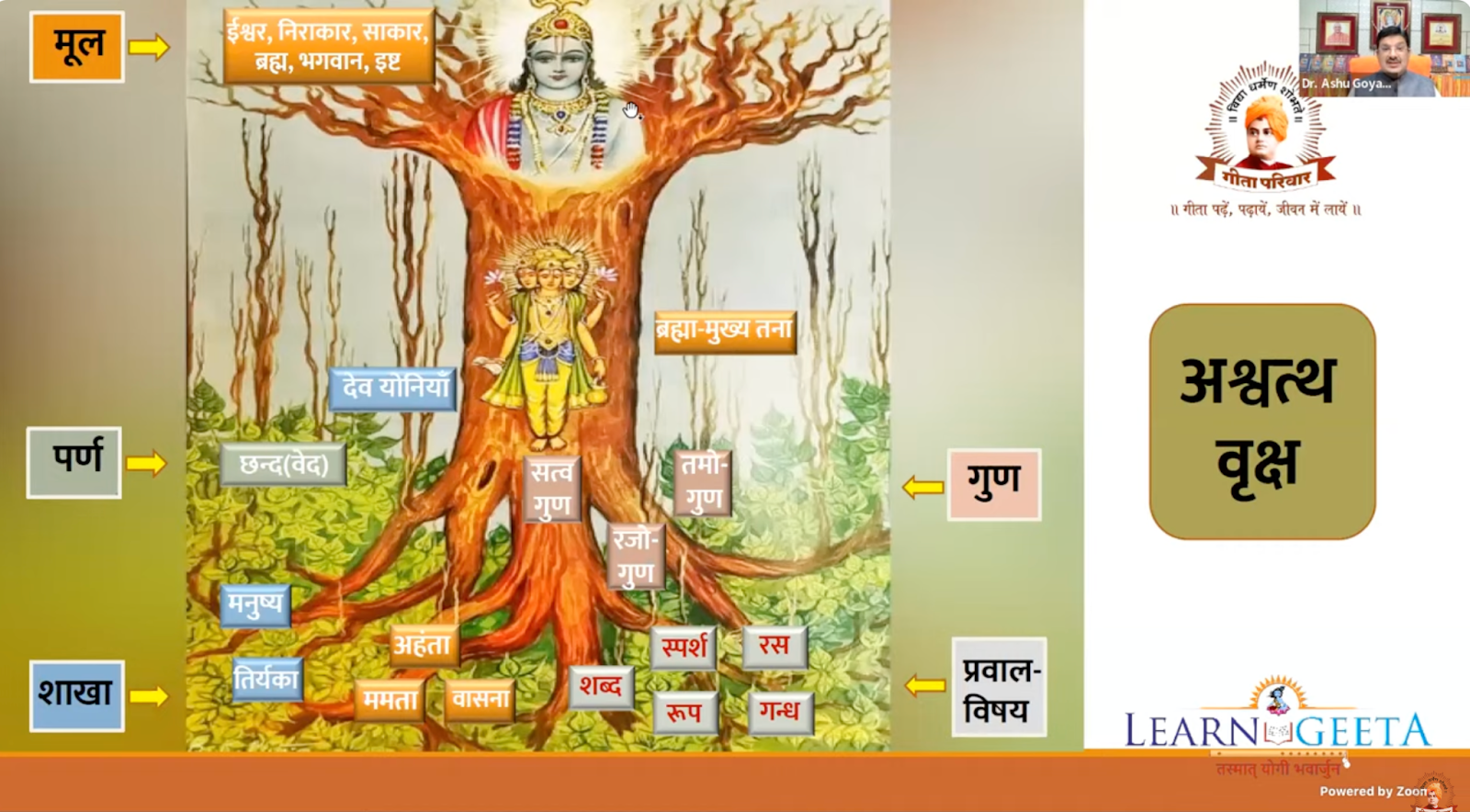
Let's try to undertsand this visually. Bhagavān compares the material world to an upside-down to an eternal aśhvatth (sacred fig) tree. On the branches of this tree, the embodied souls wander up and down, from lifetime after lifetime. The trunk and branches which are extending downwards (adhaḥ-śhākham) encompass all the life-forms from of the material realm, which are entangled in the cycle of birth and death. Bhagavān or the supreme divine personality is the source of this tree (as the root of this tree). The roots face upwards toward the sky (ūrdhva-mūlam), originaing from the Supreme Divine, nourished and supported by HIM. Its leaves are the fruitive activities defined in the Vedas or the Vedic mantras.
Once, Swamy Ram Tirtha was travelling to the United States of America. In those times, one had to travel on a ship. The captain of the ship noticed Swamy Ram Tirtha and realized that he was a learned sage by seeing the glow or Tej emanating from his face. The captain then asked Swamy Ram Tirtha if he had anyone receiving him in the United States of America. Swamy Ji replied by saying no and he asked if the captain would like to welcome him to his humble abode. The captain was delighted to welcome the sage to his humble abode and arranged for the stay of Swamy Ram Tirtha at his home. During the conversations, the captain realized that Swamy Ji was a learned mathematician as well.
When the captain's son asked for help to understand the definition of a straight line, the captain asked if Swamy Ji could explain it to his son. Swamy Ji then asked if he should respond with an answer that would help the child clear the exam or with the actual answer that has a deeper meaning. The captain was astonished as the straight line was known to be an endless one-dimensional figure that has no width. It is a combination of endless points joined on both sides of a point. Swamy Ji said that if the base of the line is on the ground and it is endless, then it starts and ends at the same point and appears as a round from outer space. He then proved in the presence of mathematicians (who got involved in this conversation due to the captain) that everything terminated as zero. Around the 7th day of his stay in the United States of America, Swamy Ji was invited to have dinner with the President of America, Mr. Roosevelt, who was impressed by Swamy Ji's knowledge and wisdom. This is the significance of knowledge and wisdom. Swamy Ji became a well-known name due to his knowledge and eisdom (or Gyaan).
The reference of ūrdhva-mūlam represents the entity of high significance. It symbolizes the supreme divine personality. The branches represent the material realm and the living entities in this material realm. These living entities are connected to the supreme divine. Without the flow of consciousness (derieved from the roots), the living entities would not be able to function. The aśhvatth (sacred fig) tree has two meanings here. The term aśhvatth signifies something which is always subjected to change or something which is not constant. The entire cosmic creation in the material is subjected to change and changes every moment. The other meaning symbolisys the aśhvatth (sacred fig) tree. The leaves of this tree are always in wavering even when there is no wind. The aśhvatth (sacred fig) tree is called eternal as it is connected to the roots which is the Supreme Divine Personality.
The leaves of aśhvatth (sacred fig) tree are compared to the Vedas. Like how one would not be able to count the leaves on a tree (considering it is vast), the knowledge of the Vedas is also considered to be vaster than the leaves of the tree. Bhagavān says that one who knows the secret of this tree is the knower of the Vedas. One needs to understand that the Gītā is the summary of the Upinashads. Many shlokas from the Gītā could be found as is in the Upinishads. This particular shloka is also seen in Kathopanishad. Bhagavān now explains this aśhvatth (sacred fig) tree further in the next shloka.
Once, Swamy Ram Tirtha was travelling to the United States of America. In those times, one had to travel on a ship. The captain of the ship noticed Swamy Ram Tirtha and realized that he was a learned sage by seeing the glow or Tej emanating from his face. The captain then asked Swamy Ram Tirtha if he had anyone receiving him in the United States of America. Swamy Ji replied by saying no and he asked if the captain would like to welcome him to his humble abode. The captain was delighted to welcome the sage to his humble abode and arranged for the stay of Swamy Ram Tirtha at his home. During the conversations, the captain realized that Swamy Ji was a learned mathematician as well.
When the captain's son asked for help to understand the definition of a straight line, the captain asked if Swamy Ji could explain it to his son. Swamy Ji then asked if he should respond with an answer that would help the child clear the exam or with the actual answer that has a deeper meaning. The captain was astonished as the straight line was known to be an endless one-dimensional figure that has no width. It is a combination of endless points joined on both sides of a point. Swamy Ji said that if the base of the line is on the ground and it is endless, then it starts and ends at the same point and appears as a round from outer space. He then proved in the presence of mathematicians (who got involved in this conversation due to the captain) that everything terminated as zero. Around the 7th day of his stay in the United States of America, Swamy Ji was invited to have dinner with the President of America, Mr. Roosevelt, who was impressed by Swamy Ji's knowledge and wisdom. This is the significance of knowledge and wisdom. Swamy Ji became a well-known name due to his knowledge and eisdom (or Gyaan).
The reference of ūrdhva-mūlam represents the entity of high significance. It symbolizes the supreme divine personality. The branches represent the material realm and the living entities in this material realm. These living entities are connected to the supreme divine. Without the flow of consciousness (derieved from the roots), the living entities would not be able to function. The aśhvatth (sacred fig) tree has two meanings here. The term aśhvatth signifies something which is always subjected to change or something which is not constant. The entire cosmic creation in the material is subjected to change and changes every moment. The other meaning symbolisys the aśhvatth (sacred fig) tree. The leaves of this tree are always in wavering even when there is no wind. The aśhvatth (sacred fig) tree is called eternal as it is connected to the roots which is the Supreme Divine Personality.
The leaves of aśhvatth (sacred fig) tree are compared to the Vedas. Like how one would not be able to count the leaves on a tree (considering it is vast), the knowledge of the Vedas is also considered to be vaster than the leaves of the tree. Bhagavān says that one who knows the secret of this tree is the knower of the Vedas. One needs to understand that the Gītā is the summary of the Upinashads. Many shlokas from the Gītā could be found as is in the Upinishads. This particular shloka is also seen in Kathopanishad. Bhagavān now explains this aśhvatth (sacred fig) tree further in the next shloka.
adhaścordhvaṃ(m) prasṛtāstasya śākhā,
guṇapravṛddhā viṣayapravālāḥ,
adhaśca mūlānyanusantatāni,
karmānubandhīni manuṣyaloke. 15.2
Fed by the three Guṇas and having sense-objects for their tender leaves, the branches of the aforesaid tree (in the shape of different orders of creation) extend both upwards and downwards; and it's roots which bind the soul according to its actions in the human body, are spread in all regions, higher as well as lower.
In this shloka, Bhagavān continues to explain that the branches of the tree extend upward and downward, nourished by the three gunas, with the objects of the senses as tender buds. Every creation in this material realm arises from Prakṛti and hence they would be under the influence of the three gunas - sattva guna (mode of goodness), Rajo guna (mode of passion) and Tamo guna (mode of ignorance).
Every embodied soul would have all the three gunas and one of the gunas would be predominant at a particular point in time. When sattva guna (mode of goodness) is predominant, one feels serene, illumined with wisdom and would be inclined towards devotional or virtuous deeds. When the Rajo guna (mode of passion) is predominant, one would undertake intense activities and would chase material goals or work towards fulfilling material desires (say wealth creation, name, fame, success, prestige etc.). When Tamo guna (mode of ignorance) is predominant, one would be gripped by laziness, sleepiness, inertia, delusion and undertake mundane activities or harmful activities. When one identifies the influence of the three gunas, one would understand the reason for one's nature and behavior. The living entities (branches) are nourished by the three gunas.
The elevated souls such as the celestial devatas are the branches towards the supreme divine, then the branches towards the middle represents the human clan and the branches which move downwards represent the animal kingdom. The objects of the senses are referred to as tender buds of this tree. The objects of senses are the senses of sight, taste, hearing, touching and the ability to smell.
The reason why one is entangled in the cycle of birth and death is due to the below three reasons:
- (1) Ahamta (ME or I consciousness - I am the doer)
- (2) Mamata (mine - say my home, my property, my wife) and
- (3) Vāsanās - (the desire to obtain more).
One is entangled in karmic reactions or cycles due to the deeds performed under the influence of the above three entities. Depending upon the karmic reactions accumulated in the past lifetimes, one attains the next life as human or any other species in the animal kingdom, If a lion eats a prey, it is not bounded by karma. It is only in the human form where one is bounded by karma. If one has attained a human form and is on the path of Gītā, it must be due to the virtuous deeds performed in the past lives. One can perform virtuous deeds in the human form and accumulate positive karmic points or perform austerities to try and negate sinful activities that were performed in the past.
When one experiences miseries, one tends to shift blame on the divine. One sees impartiality in the divine laws by comparing the situation with the other. However, one needs to understand that pleasure and pain are the two sides of the same coin. Everyone in this material realm will have to experience the dualities of life (say pleasure and pain; happiness and misery; profit and loss, so on and so forth) based on one's karma. Life would keep throwing bitter lemons at various stages. One could either choose to remain bitter or make a lemonade out of these experiences and evolve as an individual.
We should consider HIM like rain. As we sow the seeds, so comes the harvest. HE is only showering the rain of HIS grace but the results we get as per the seeds seeds sown. Whatever action is carried out directly or indirectly one gets the results accordingly.
While in the human form the soul performs karmas, which is the trunk of the tree, and its branches (śhākhās) extend both upward and downward. Based on how the soul performed in its past and present forms it is reborn. If it led a virtuous life, when reborn, it moves to the upward branches which denote the celestial abodes of the gandharvas, devatās, and so on. In case, a soul was involved in sinful acts, in the next birth, it gets degraded to the downwards branches, which are for the animal kingdom.
na rūpamasyeha tathopalabhyate,
nānto na cādirna ca sampratiṣṭhā,
aśvatthamenaṃ(m) suvirūḍhamūlam,
asaṅgaśastreṇa dṛḍhena chittvā. 15.3
The nature of this tree of creation, does not on mature thought, turn out what it is represented to be; for it has neither beginning nor end, nor even stability. Therefore cutting down this Pīpala tree, which is m
Now, one would contemplate on how this sacred fig tree can be found or seen in this material realm. In this shloka, Bhagavān explains that the real form of this tree is not perceived in this world, neither its beginning nor end, nor its continued existence. This is only a representation of how the material world is structured and connected to the supreme divine.
In the previous shloka, Bhagavān has explained that the buds of this tree are the objects of the senses. These objects of the senses (i.e., sense of sight, touch, hearing, taste and ability to smell) when in contact with the pleasures of the material realm, develop desires. One desire leads to another, and it leads to a chain of desires. Hence, Bhagavān mentions that this deep-rooted aśhvatth tree must be cut down with a strong axe of detachment.
The human mind has a limited capacity and is unable to comprehend the infinite manifestations which is beyond one's imagination. In this cosmic creation, there are many other galaxies in addition to our spiral galaxy (which has astronomical number or unimaginable number of stars, planets and solar systems). Imagining the vastness of this cosmic creation is beyond the imagination of the human mind.
Consider the example of a paper. which has to be destroyed (say by burning or shredding). In quantum physics, it is stated that energy can neither be created nor destroyed. It can only be converted from one form to another. Similarly, this aśhvatth tree (sacred fig tree) is eternal and it can be perceived in an alternate form. Hence, Bhagavān has explained that the real form of this tree is not perceived in this world, neither its beginning nor end, nor its continued existence. when one attains self-realization, one realizes that one is a small fragment of HIS supreme divine.
As Bhagavān Shankaracharya says:
In the previous shloka, Bhagavān has explained that the buds of this tree are the objects of the senses. These objects of the senses (i.e., sense of sight, touch, hearing, taste and ability to smell) when in contact with the pleasures of the material realm, develop desires. One desire leads to another, and it leads to a chain of desires. Hence, Bhagavān mentions that this deep-rooted aśhvatth tree must be cut down with a strong axe of detachment.
The human mind has a limited capacity and is unable to comprehend the infinite manifestations which is beyond one's imagination. In this cosmic creation, there are many other galaxies in addition to our spiral galaxy (which has astronomical number or unimaginable number of stars, planets and solar systems). Imagining the vastness of this cosmic creation is beyond the imagination of the human mind.
Consider the example of a paper. which has to be destroyed (say by burning or shredding). In quantum physics, it is stated that energy can neither be created nor destroyed. It can only be converted from one form to another. Similarly, this aśhvatth tree (sacred fig tree) is eternal and it can be perceived in an alternate form. Hence, Bhagavān has explained that the real form of this tree is not perceived in this world, neither its beginning nor end, nor its continued existence. when one attains self-realization, one realizes that one is a small fragment of HIS supreme divine.
As Bhagavān Shankaracharya says:
ब्रह्म सत्यं जगन-मिथ्या जीवो ब्रह्मैव नापरः
It means that Brahmān is the only Truth, the material world is unreal (objectively or illusory), and there is ultimately no difference between Brahmān and the individual self.
na rūpamasyeha tathopalabhyate nānto na cādirna ca sampratiṣṭhā |
aśvatthamenaṃ suvirūḍhamūla masaṅgaśāstreṇa dṛḍhena cittvā || 3||
Bhagavān then says that this deep-rooted aśhvatth tree must be cut down with a strong axe of detachment. One needs to perform only the prescribed duties in the material world.
Let's say, one is essaying the role of Meghanad on a stage. During the drama, the actor would say that Ravana is his father, with full emotions. However, in the back of the actor's mind, he is aware that what he says is not the reality. Similarly, we all play various roles (say mother, father, friend, sibling, teacher, so on and so forth) and one needs to perform the prescribed duty in every role. However, one needs to be aware that one is not this material body, but an eternal spiritual being.
As Jagadguru Adi Shankaracharya Ji says:
na rūpamasyeha tathopalabhyate nānto na cādirna ca sampratiṣṭhā |
aśvatthamenaṃ suvirūḍhamūla masaṅgaśāstreṇa dṛḍhena cittvā || 3||
Bhagavān then says that this deep-rooted aśhvatth tree must be cut down with a strong axe of detachment. One needs to perform only the prescribed duties in the material world.
Let's say, one is essaying the role of Meghanad on a stage. During the drama, the actor would say that Ravana is his father, with full emotions. However, in the back of the actor's mind, he is aware that what he says is not the reality. Similarly, we all play various roles (say mother, father, friend, sibling, teacher, so on and so forth) and one needs to perform the prescribed duty in every role. However, one needs to be aware that one is not this material body, but an eternal spiritual being.
As Jagadguru Adi Shankaracharya Ji says:
पुनरपि जननं पुनरपि मरणं,पुनरपि जननी जठरे शयनम्।
इह संसारे बहुदुस्तारे,कृपयाऽपारे पाहि मुरारे ॥
Undergoing the pangs of birth again and again, passing through the throes of death again and again, lying in the mother's womb over and over again, this process of Samsara is hard to cross over. Save me from it soon, Oh, Merciful Lord!
One is entangled in the cycle of birth and death due to material desires as one identifies oneself with this material body.
Once Shukdev Ji developed an element of pride that he was the son of Ved Vyaas. His father Ved Vyaas Ji asked Shukdev Ji to spend time in the material world (instead of forests and Himalayas) to understand how the material world functions. He advises Shukdev Ji to approach king Janak to understand more about Samsara or the material realm. Shukdev Ji was taken aback as he was the son of a great sage, and he was asked to learn from a king. Mother Sita's father was the 49th Janak. Hence, Janak here refers to a state or a position in this context and the Janak referred here in this example is not the one who is the father of Mother Sita. Shukdev Ji then approaches king Janak's kingdom and instructs the gatekeeper to inform the king that the most dearest son of the great sage Ved Vyas (Shukdev) is here to see the king. When King Janak receives this information, he instructs the gatekeeper to inform Shukdev Ji to wait for a while. The gatekeeper was surprised as usually the sages are welcomed immediately without keeping them waiting near the entrance. When Shukdev Ji learnt that he had to wait, his ego was hurt and then then thought that the gatekeeper might not have informed the king that he is the son of the great sage Ved Vyaas. He asks the gatekeeper to inform the king about his introduction once again. The gatekeeper informs the king and again comes back to Shukdev Ji with a message that the king has asked him to wait. Shukdev Ji was surprised and he then thought that his self-introduction was too much for the gatekeeper to comprehend and he cuts short his introduction. However, the king still asks him to wait and this cycle continues for a period of three days.
Shukdev Ji then realised that he was wrong in intoducing himself as the son of the great sage Ved Vyaas. He then asks the gatekeeper to inform the king that his disciple Shukdev is here to meet him. When the gatekeeper informs the king, the king asks the gatekeeper to invite Shukdev Ji inside his court. Shukdev Ji is welcomed with hospitality. The king then informs Shukdev Ji that it is the Kul-Devi's pooja and the whole city is decorated with lights, flowers etc. King Janak mentions to Shukdev Ji that on this occasion, a Mahatma needs to hot the pot filled with oil in his hands and take a walk around the city. Shukdev Ji was exhausted as he had been waiting near the entrance for more than three days, however he agrees to complete this task. King Janak says that the condition to complete this task is to ensure that even a drop of oil should not fall on the ground. Shukdev Ji completes one round around the city by carefully carrying the pot filled with oil until the brim. When he returns, King Janak asks if Shukdev Ji saw the grandly decorated city, its scenic beauty, the waterfalls and other places. Shukdev Ji says that all his focus was to ensure that even a drop of oil does not fall on the ground and hence he was unable to observe anything within the city. King Janak says that he his purpose of visiting to learn the required wisdom had been imparted. Shukdev Ji then realized that by refraining from the material world and living in isolation in forest or Himalayas is not the only form of Vairāgya, but the true Vairāgya is to stay in the material world and remain unaffected by its pleasures and distractions. One can attain this state of Vairāgya or detachment by fixing the mind on the divine while performing the prescribed duties.
Swamy Ram Shukdas Ji Maharaj has adviced the below to attain this state of detachment:
One is entangled in the cycle of birth and death due to material desires as one identifies oneself with this material body.
Once Shukdev Ji developed an element of pride that he was the son of Ved Vyaas. His father Ved Vyaas Ji asked Shukdev Ji to spend time in the material world (instead of forests and Himalayas) to understand how the material world functions. He advises Shukdev Ji to approach king Janak to understand more about Samsara or the material realm. Shukdev Ji was taken aback as he was the son of a great sage, and he was asked to learn from a king. Mother Sita's father was the 49th Janak. Hence, Janak here refers to a state or a position in this context and the Janak referred here in this example is not the one who is the father of Mother Sita. Shukdev Ji then approaches king Janak's kingdom and instructs the gatekeeper to inform the king that the most dearest son of the great sage Ved Vyas (Shukdev) is here to see the king. When King Janak receives this information, he instructs the gatekeeper to inform Shukdev Ji to wait for a while. The gatekeeper was surprised as usually the sages are welcomed immediately without keeping them waiting near the entrance. When Shukdev Ji learnt that he had to wait, his ego was hurt and then then thought that the gatekeeper might not have informed the king that he is the son of the great sage Ved Vyaas. He asks the gatekeeper to inform the king about his introduction once again. The gatekeeper informs the king and again comes back to Shukdev Ji with a message that the king has asked him to wait. Shukdev Ji was surprised and he then thought that his self-introduction was too much for the gatekeeper to comprehend and he cuts short his introduction. However, the king still asks him to wait and this cycle continues for a period of three days.
Shukdev Ji then realised that he was wrong in intoducing himself as the son of the great sage Ved Vyaas. He then asks the gatekeeper to inform the king that his disciple Shukdev is here to meet him. When the gatekeeper informs the king, the king asks the gatekeeper to invite Shukdev Ji inside his court. Shukdev Ji is welcomed with hospitality. The king then informs Shukdev Ji that it is the Kul-Devi's pooja and the whole city is decorated with lights, flowers etc. King Janak mentions to Shukdev Ji that on this occasion, a Mahatma needs to hot the pot filled with oil in his hands and take a walk around the city. Shukdev Ji was exhausted as he had been waiting near the entrance for more than three days, however he agrees to complete this task. King Janak says that the condition to complete this task is to ensure that even a drop of oil should not fall on the ground. Shukdev Ji completes one round around the city by carefully carrying the pot filled with oil until the brim. When he returns, King Janak asks if Shukdev Ji saw the grandly decorated city, its scenic beauty, the waterfalls and other places. Shukdev Ji says that all his focus was to ensure that even a drop of oil does not fall on the ground and hence he was unable to observe anything within the city. King Janak says that he his purpose of visiting to learn the required wisdom had been imparted. Shukdev Ji then realized that by refraining from the material world and living in isolation in forest or Himalayas is not the only form of Vairāgya, but the true Vairāgya is to stay in the material world and remain unaffected by its pleasures and distractions. One can attain this state of Vairāgya or detachment by fixing the mind on the divine while performing the prescribed duties.
Swamy Ram Shukdas Ji Maharaj has adviced the below to attain this state of detachment:
- (1) What one receives from this material world, one needs to return the same (say wealth, rice, knowledge etc) without having any expectation.
- (2) Relinquishing the material pleasures of this material world.
- (3) By refraining from seeking refuge in material pleasures.
- (4) By relinquishing the I or ME consciousness or the sense of doer-ship
- (5) By believing that one is a fragment of the supreme divine
tataḥ(ph) padaṃ(n) tatparimārgitavyaṃ(y̐),
yasmingatā na nivartanti bhūyaḥ,
tameva cādyaṃ(m) puruṣaṃ(m) prapadye,
yataḥ(ph) pravṛttiḥ(ph) prasṛtā purāṇī.15.4
Thereafter a man should diligently seek for that supreme state, viz.,God, having attained which they return no more to this world; and having fully resolved that he stands dedicated to the Primeval Being (God Nārāyaṇa) Himself, for whom the flow of this beginningless creation has progressed, he should dwell and meditate on Him.
In this shloka, Bhagavān says that after the deep-rooted tree has been cut down with the axe of detachment, one must search out the base of the tree, which is the Supreme Divine, from whom the entire cosmic creation has come into existence. Upon taking refuge in the supreme divine, one will not return to this world again.
Consider a water drop which merges into the ocean. Once it merges, it is practically impossible to search for that particular drop from the vast ocean. Similarly, when one seeks refuge in the divine and has attained HIM, when one attains liberation from the cycle of birth and death, one never returns to this material world ever again. Therefore, the only way to cut down the aśhvatth tree is by totally surrendering to the Supreme Divine and taking HIS refuge. By doing this, one will not return to this material world, and after death will go to HIS divine Abode.
nirmānamohā jitasaṅgadoṣā,
adhyātmanityā vinivṛttakāmāḥ,
dvandvairvimuktāḥ(s) sukhaduḥkhasañjñaiḥ(r),
gacchantyamūḍhāḥ(ph) padamavyayaṃ(n) tat. 15.5
They who are free from pride and delusion, who have conquered the evil of attachment, and are constantly abiding in God, whose cravings have altogether ceased and who are completely immune to all pairs of opposites going by the names of pleasure and pain, and are undeluded, attain that supreme immortal state.
In this shloka, Bhagavān has explained the traits for complete surrender towards HIM. This quality of exclusive and complete surrender has been explained very well in the the Bhajan given below:
The Bhajan explains that one is not the material body, not the material mind and intellect. One is the small fragment of the supreme divine and hence one needs to relinquish the sense of doer ship and the sense of ME or MINE consciousness. One is always constantly chasing the material goals and desires from a state ME consciousness, which is never ending.
The embodied souls have an illusion that the pleasures of the material realm is permanent and continue accumulating more. Their minds are blinded by pride and ignorance, they think that all this is for their enjoyment, and would continue giving them happiness. A soul in such a state does not comprehend the supreme divine as the owner of all and would not be able to surrender to HIM unconditionally.
Those who are free from delusion of the material realm, who are equipoised towards the dualities of life (say pleasure and pain; happiness and misery; honor and dishonor; profit and loss; victory and defeat, etc.,) who have overcome the sense of attachment towards material pleasures, who have unconditionally surrendered to the divine, such liberated souls attain HIS eternal Abode. However, the current reality is that the embodied souls are gripped by sadness even with the slightest of challenges. There are students who are depressed for scoring 99.99 %.
Once, there was a man who was upset that he had a loss of Rupees five lakh and was expressing his sadness to his friend. However, the friend observed that the man's wife was unaffected by this situation. When he enquired further, she mentioned that her husband expected a profit of 10 Lakhs and received five Lakhs instead and is hence perceiving the same as a loss of five lakh rupees. Happiness is a state of mind, an internal state, which is not affected by external situations.
Bhagavān explains HIS divine abode in the next shloka and then explains HIS Purushottam Swarup in the forthcoming shlokas which will be explained in the next session.
The session ends with prayer and Hanuman chalisa.
Question and Answer
Sunil Ji
Question: Does one have to relinquish Karma to attain liberation?
Answer: One has to relinquish the desire towards the fruits of Karma and not the karma or action itself. Whether the result of an action is favorable or unpleasant, one needs to remain equipoised and relinquish the sense of doer ship.
Lakshmikanth Ji
Question: Moksha or liberation is freedom from the mind or Jeevatma?
Answer: The mind is limited to the material realm and the soul is a part of the supreme divine. When one realises this truth, it is the state of Aham Brahmāsmi. Liberation from the cycle of death is relevant to the Jeevatma and not the material mind.
Seema Ji
Question: It is the intellect which drives the action of the body and not the Jīvātmā. What directs the intellect and why is it called the root?
Answer: Like how the fan runs with electricity, the consciousness is the reason why the physical body (including the intellect) functions. When one undergoes the process of death, the Jīvātmā gets separated from the physical body and hence the physical body is devoid of consciousness. One can see no difference between various parts of the body (say eye or hands) as they cannot function. Hence, it is the jeevatma which directs or is the reason which makes the human body function.
Gaurav Ji
Question: If one has performed virtuous tasks the entire life and at the moment of death, if the focus shifts to an insect or some mundane thing, the next life is based on the last moment.
Answer: If one has lived the entire life with predominant sattva guna, one would die with the same mindset at the time of death. This is the same with predominant Rajo or Tamo guna. Hence, with practice, one needs to be absorbed in devotion until the last moment.
Meena Ji
Question: How can one imbibe the Gītā by being in family life?
Answer: The traits of an ideal devotee is explained in Chapter 12. By being equipoised during the dualities of life, by seeing friends and foes with equal vision, by not harboring hatred and being a well-wisher of one and all, one can imbibe the teachings in family life.
Rani Ji
Question: Does one need to dedicate the fruits of all actions to Śrī Krishna only?
Answer: One can dedicate the fruits of all actions to the personal form (say Ram Ji, Krishna Ji, Durga Maata, etc.,) in which one sees the divine. In the Gītā, it is the supreme almighty imparting the divine knowledge in the personal form of Śrī Krishna. In Mahabharat, when Krishna speaks, it is Vasudev Uvacha. However, in Gītā, it is mentioned as Śrī Bhagavān Uvacha, which represents the supreme divine personality.
Question: When one is a fragment of the divine, who performs good and bad deeds?
Answer: Arjuna also mentions that he is the knower of Vedas, belonging to Kuru family and enquires who performs bad deeds. Bhagavān answers that it is the desires which fuels greed and inturn greed fuels more deires which results in bad deeds. With constant practice, one can detach from the material pleasures to overcome greed and desires that arise from Rajo guna.
Question: At times, one feels disinterested in devotional activities. How to overcome this?
Answer: All the three gunas are present in all persons. When sattva guna is predominant, one will be able to engage in devotional activities. When Rajo guna is predominant, one is inclined to perform intense activities and chase material goals. When Tamo guna is high, one feels lethargic and is gripped by inertia. Hence, depending on the predominant guna, the behavior is impacted.
Srikanth Ji
Question: How can one overcome the desires triggered by Rajo guna?
Answer: When one executes actions by relinquishing the sense of doer-ship, one can rise above Rajo guna.
Question: How to find a true Guru?
Answer: The Guru should belong to a Guru-shishya sampradaya and should not be a self-proclaimed Guru. He should understand the scriptures and should help the disciple develop exclusive devotion towards the divine instead of him.
The embodied souls have an illusion that the pleasures of the material realm is permanent and continue accumulating more. Their minds are blinded by pride and ignorance, they think that all this is for their enjoyment, and would continue giving them happiness. A soul in such a state does not comprehend the supreme divine as the owner of all and would not be able to surrender to HIM unconditionally.
Those who are free from delusion of the material realm, who are equipoised towards the dualities of life (say pleasure and pain; happiness and misery; honor and dishonor; profit and loss; victory and defeat, etc.,) who have overcome the sense of attachment towards material pleasures, who have unconditionally surrendered to the divine, such liberated souls attain HIS eternal Abode. However, the current reality is that the embodied souls are gripped by sadness even with the slightest of challenges. There are students who are depressed for scoring 99.99 %.
Once, there was a man who was upset that he had a loss of Rupees five lakh and was expressing his sadness to his friend. However, the friend observed that the man's wife was unaffected by this situation. When he enquired further, she mentioned that her husband expected a profit of 10 Lakhs and received five Lakhs instead and is hence perceiving the same as a loss of five lakh rupees. Happiness is a state of mind, an internal state, which is not affected by external situations.
Bhagavān explains HIS divine abode in the next shloka and then explains HIS Purushottam Swarup in the forthcoming shlokas which will be explained in the next session.
The session ends with prayer and Hanuman chalisa.
Question and Answer
Sunil Ji
Question: Does one have to relinquish Karma to attain liberation?
Answer: One has to relinquish the desire towards the fruits of Karma and not the karma or action itself. Whether the result of an action is favorable or unpleasant, one needs to remain equipoised and relinquish the sense of doer ship.
Lakshmikanth Ji
Question: Moksha or liberation is freedom from the mind or Jeevatma?
Answer: The mind is limited to the material realm and the soul is a part of the supreme divine. When one realises this truth, it is the state of Aham Brahmāsmi. Liberation from the cycle of death is relevant to the Jeevatma and not the material mind.
Seema Ji
Question: It is the intellect which drives the action of the body and not the Jīvātmā. What directs the intellect and why is it called the root?
Answer: Like how the fan runs with electricity, the consciousness is the reason why the physical body (including the intellect) functions. When one undergoes the process of death, the Jīvātmā gets separated from the physical body and hence the physical body is devoid of consciousness. One can see no difference between various parts of the body (say eye or hands) as they cannot function. Hence, it is the jeevatma which directs or is the reason which makes the human body function.
Gaurav Ji
Question: If one has performed virtuous tasks the entire life and at the moment of death, if the focus shifts to an insect or some mundane thing, the next life is based on the last moment.
Answer: If one has lived the entire life with predominant sattva guna, one would die with the same mindset at the time of death. This is the same with predominant Rajo or Tamo guna. Hence, with practice, one needs to be absorbed in devotion until the last moment.
Meena Ji
Question: How can one imbibe the Gītā by being in family life?
Answer: The traits of an ideal devotee is explained in Chapter 12. By being equipoised during the dualities of life, by seeing friends and foes with equal vision, by not harboring hatred and being a well-wisher of one and all, one can imbibe the teachings in family life.
Rani Ji
Question: Does one need to dedicate the fruits of all actions to Śrī Krishna only?
Answer: One can dedicate the fruits of all actions to the personal form (say Ram Ji, Krishna Ji, Durga Maata, etc.,) in which one sees the divine. In the Gītā, it is the supreme almighty imparting the divine knowledge in the personal form of Śrī Krishna. In Mahabharat, when Krishna speaks, it is Vasudev Uvacha. However, in Gītā, it is mentioned as Śrī Bhagavān Uvacha, which represents the supreme divine personality.
Question: When one is a fragment of the divine, who performs good and bad deeds?
Answer: Arjuna also mentions that he is the knower of Vedas, belonging to Kuru family and enquires who performs bad deeds. Bhagavān answers that it is the desires which fuels greed and inturn greed fuels more deires which results in bad deeds. With constant practice, one can detach from the material pleasures to overcome greed and desires that arise from Rajo guna.
Question: At times, one feels disinterested in devotional activities. How to overcome this?
Answer: All the three gunas are present in all persons. When sattva guna is predominant, one will be able to engage in devotional activities. When Rajo guna is predominant, one is inclined to perform intense activities and chase material goals. When Tamo guna is high, one feels lethargic and is gripped by inertia. Hence, depending on the predominant guna, the behavior is impacted.
Srikanth Ji
Question: How can one overcome the desires triggered by Rajo guna?
Answer: When one executes actions by relinquishing the sense of doer-ship, one can rise above Rajo guna.
Question: How to find a true Guru?
Answer: The Guru should belong to a Guru-shishya sampradaya and should not be a self-proclaimed Guru. He should understand the scriptures and should help the disciple develop exclusive devotion towards the divine instead of him.