
विवेचन सारांश
The Eternal Essence of the Soul and Its Divine Connection to Bhagavan, the Supreme Divine
The discourse commenced with the ceremonial lighting of the Dīpam (lamp) at the lotus feet of Śrī Bhagavān, invoking divine grace and filling the gathering with profound Bhakti and reverence.
Vasudevasutam Devam, Kaṁsacāṇūramardanam
Devakīparamānandam, Kṛṣṇam Vande Jagadgurum
Yogeśam Saccidānandam, Vāsudevam Vrajapriyam
Dharmasaṁsthāpakam Vīram, Kṛṣṇam Vande Jagadgurum
By the grace of the Supreme Divine, a seeker is blessed with the rare opportunity to study, imbibe, and integrate the sacred wisdom of the Gītā into daily life. This privilege may stem from past or present karmic merits, the blessings of ancestors, or the grace of a revered Guru.
In truth, we have not chosen to study the Gītā—rather, the Gītā has chosen us. It is only through divine intervention that we are graced with the wisdom of this sacred scripture. Without Bhagavān’s blessing, neither true understanding nor spiritual realization of the Gītā would be possible.
As we strive to bring the teachings of the Gītā into our lives, we find ourselves uplifted, guided, and transformed. The more we embrace its wisdom, the more elevated we become in our spiritual journey.
Breaking Free from the Cycle of Birth and Death
In last week’s discourse, we began exploring the 15th Chapter of the Bhagavad Gītā, where Bhagavān uses the powerful metaphor of an inverted tree to illustrate the nature of the Brahmāṇḍa (cosmic existence). This chapter is regarded as a Śhāstra, and Bhagavān explains how the roots of this tree—Mamatā (possessiveness), Vāsanā (latent desires), and Ahantā (ego)—keep us entangled in the endless cycle of birth and death.
Through countless lifetimes, we wander through the 14 realms (Lokas)—sometimes as devas (celestial beings), humans, animals, birds, or even insects. Our good karmas elevate us to higher realms, while bad karmas push us into lower existences. If our karmas are mixed, we return to the Manuṣya Yoni (human birth). In this way, we cycle through 8.4 million species of life, continuing this journey for countless eons.
But does this cycle go on forever? Is there a way out? What is the solution?
Bhagavān provides the answer:
"asaṅga-śhastreṇa dṛiḍhena chhittvā"
—This deep-rooted Aśvattha tree must be cut down with the strong axe of detachment.
Detachment: The Key to Liberation
From what must we detach? Bhagavān teaches that we must detach from our attachment to worldly objects and experiences.
We reflected on the story of Śukadeva Mahāmuni and how he learned detachment from Rāja Janaka. Despite witnessing the splendor of Mathurā, his mind remained absorbed in the oil-laden lamp, unwavering in focus. Similarly, he remained unaffected by the grandeur of Mithilā because his consciousness was centered on a higher purpose.
Likewise, if we fix our minds on Bhagavān, life will continue as it is, but rāga (attachment) and dveṣa (aversion) will no longer disturb us. Once we detach from worldly obsessions, our inner state transforms.
Bhagavān describes this condition in the following verse:
nirmāna-mohā jita-saṅga-doṣhā,
adhyātma-nityā vinivṛitta-kāmāḥ
dvandvair vimuktāḥ sukha-duḥkha-sanjñair,
gachchhanty amūḍhāḥ padam avyayaṁ tat (15.5)
"Those who are free from vanity and delusion, who have overcome the evil of attachment, who dwell constantly on the Self and on God, who are free from the desire to enjoy the senses, and who have transcended the dualities of pleasure and pain—such liberated souls attain My eternal Abode."
Thus, the path to liberation lies in detachment, inner focus, and unwavering devotion to Bhagavān. By doing so, we break free from the endless cycle of birth and death and attain the imperishable, eternal realm of the Supreme.
Reflections on the Divine Realm and the Path to Liberation
Pujya Swamiji recently recorded a podcast, which is expected to be released soon. In it, he mentioned that one of his favorite verses from the Bhagavad Gītā is:
"nirmāna-mohā jita-saṅga-doṣhā,
adhyātma-nityā vinivṛitta-kāmāḥ
dvandvair vimuktāḥ sukha-duḥkha-sanjñair,
gachchhanty amūḍhāḥ padam avyayaṁ tat" (15.5)
With the aid of slides, we explored, studied, and understood the first part of this chapter. In the sixth verse, Bhagavān beautifully describes His divine realm:
"na tad bhāsayate sūryo na śhaśhāṅko na pāvakaḥ
yad gatvā na nivartante tad dhāma paramaṁ mama" (15.6)
"Neither the sun, nor the moon, nor fire illumines that Supreme Abode of Mine. Having reached there, one never returns to this material world."
This transcendental realm lies beyond the physical universe, where liberated souls are freed from the endless cycle of birth and death.
The seventh verse of this chapter is one of the most revered in the Bhagavad Gītā, particularly in the context of Jñāna Yoga (the path of knowledge).
15.7
mamaivāṃśo jīvaloke, jīvabhūtaḥ(s) sanātanaḥ,
manaḥ(ṣ) ṣaṣṭhānīndriyāṇi, prakṛtisthāni karṣati. 15.7
Bhagavān declares to Arjuna that every living being is an eternal part of Him. Just as a spark is inseparable from fire, the jīvātmā (individual soul) is an indivisible fragment of Paramātmā (the Supreme Soul). There is no fundamental difference between them, for the very essence of the jīvātmā is none other than Bhagavān Himself. The jīvātmā is not separate—it is His divine fragment.
- mamaivānśho- "All living beings are My eternal fragmental parts."
- Purātana means something ancient, something that existed long ago. This is why we refer to our scriptures as Purāṇas—they hold wisdom from time immemorial.
- But our Dharma is not Purātana; it is Sanātana, meaning it was never created at any specific time. It has always existed, exists now, and will always exist. It is self-established, just as Paramātmā has existed forever and so has our jīvātmā.
"nānto na chādir na cha sampratiṣhṭhā" (13.12)
"It has neither a beginning nor an end, nor is it something newly established."
This endless cycle of birth and death is beautifully captured in the verse:
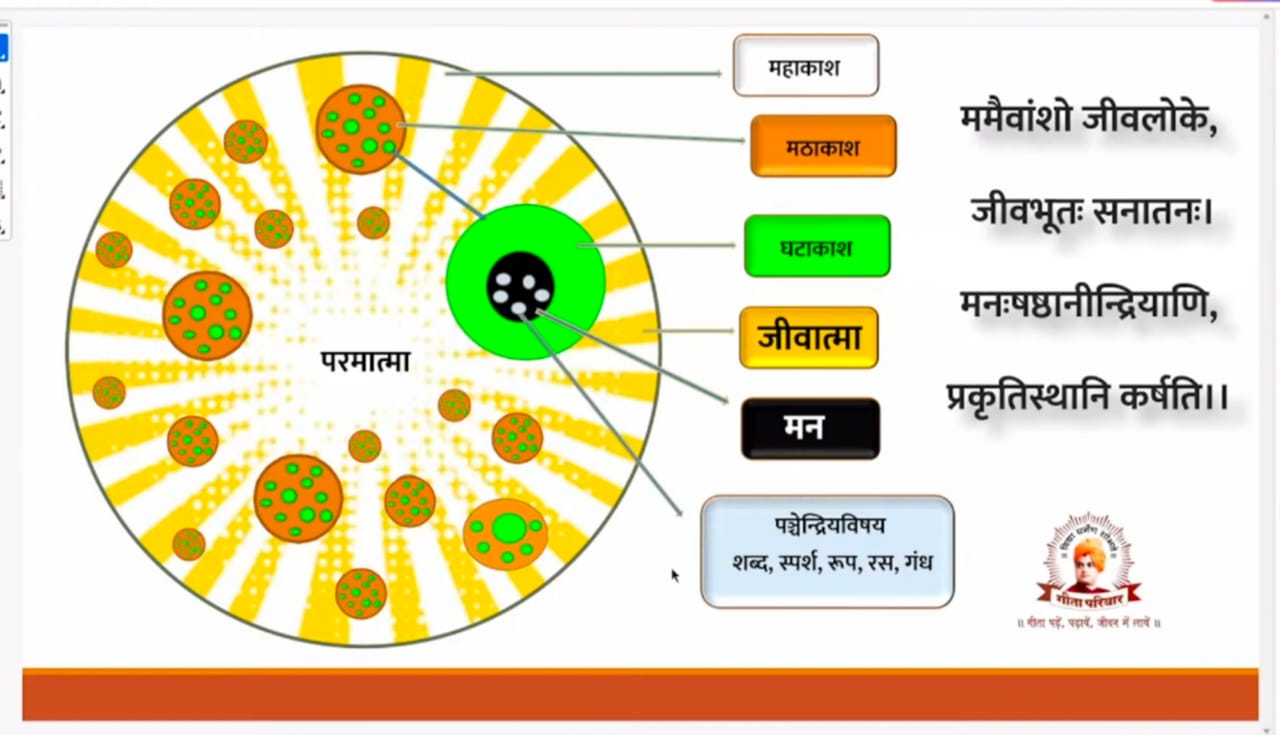
The Analogy of Mahākāśa, Mathākāśa, and Ghaṭākāśa
To explain the oneness of the jīvātmā and Paramātmā, Swamiji used a beautiful analogy of three types of space:
1. Mahākāśa (Infinite Space)
This represents the vast, boundless sky—symbolizing the Supreme Consciousness, Paramātmā. Just as the space outside a house is limitless and unrestricted, Paramātmā is all-pervading, without boundaries.
2. Mathākāśa (Contained Space)
Within this infinite sky, there are enclosures—houses, temples, or rooms. The space inside these enclosures appears separate from the sky outside, yet it is still part of the same space. This represents different realms of existence, such as planets, galaxies, and dimensions of creation.
3. Ghaṭākāśa (Pot-Space)
Inside a house, there are smaller containers, like pots. The air inside a pot seems different from the air in the room, yet it is the same. This represents the jīvātmā (individual soul), which appears separate due to its attachment to the body and mind.
Though space within a pot may seem different from the vast sky outside, in reality, it is the same space. When the pot breaks, the enclosed space merges seamlessly with the infinite sky. Similarly, when illusion (māyā) is removed, the jīvātmā realizes its oneness with Paramātmā.
A Simple Example to Understand Oneness
Imagine the sky above a glass, inside a room, and outside a house. Is it different or the same? It is one.
However, the temperature outside might be 30°C, while inside the room, it might be 28°C, and within the glass, it might be slightly cooler. Though the space is one, our perception makes it feel different.
Now, if we break the glass, the enclosed space merges with the room’s space. If we demolish the house, the space within merges with the outer sky. It was always one, but when the enclosures break, we realize its oneness.
Similarly, Paramātmā exists in all forms—as Mahākāśa, Mathākāśa, and Ghaṭākāśa. In the same way, Paramātmā exists within all of us as the jīvātmā, and therefore, everything is ultimately one.
The River and the Ocean: Another Perspective
If we pour water from a pot into a river, it becomes one with the river. If the river merges into the ocean, it becomes one with the ocean. Before merging, we see boundaries—the pot, the river, the ocean—but are they truly separate?
Likewise, the jīvātmā appears separate from Paramātmā, but this is only due to illusion. The moment we transcend attachments and ego, we realize our eternal oneness with Bhagavān. This realization is the essence of spiritual wisdom and the path to liberation.
The One Soul in All Beings
When we hear the word "soul," we often assume that each of us has a different soul. However, this is not true. The jīvātmā in all beings is the same in essence, just as the electricity in different homes is the same, though it appears separate due to different connections.
Let’s understand this through an example:
Imagine a nuclear power plant generating electricity. This electricity is:
1. Transmitted to the national grid,
2. Supplied to different states,
3. Distributed to cities,
4. Sent to local transformers,
5. Finally delivered to individual homes through power lines.
Now, within our homes, we access electricity through switches to power different appliances.
• If we turn on a light or a fan, does the electricity change? No, it remains the same source of power.
• The electricity in our house and in our neighbor's house—is it different? No, it is the same energy flowing through separate circuits.
• The electricity used in another city or state—is it different? Again, it is the same energy.
Why Do We Receive Different Electricity Bills?
Even though the electricity is one, the billing is different for each household based on usage. The more electricity we consume, the higher our bill.
Similarly, though the jīvātmā in all beings is the same, each individual experiences different karmaphala (results of actions). The karma account of each soul determines their experiences, births, and circumstances.
• Our karmas may differ, but the jīvātmā is one.
• Just as electricity remains unchanged despite different usages and bills, the essence of the soul remains unchanged despite individual karmic journeys.
This karmic accounting is why we continue to take birth again and again—until we transcend karma and realize our eternal oneness with Bhagavān.
Bhagavān further explains this profound truth in the next verse…
śarīraṃ(y̐) yadavāpnoti, yaccāpyutkrāmatīśvaraḥ,
gṛhītvaitāni saṃyāti, vāyurgandhānivāśayāt.15.8
In this verse, Śrī Bhagavān presents a brilliant metaphor to explain the soul’s journey through lifetimes.
He compares it to the movement of wind—vāyur gandhān ivāśayāt—which has a remarkable characteristic:
It carries everything but holds nothing.
Wind can transport the fragrance of flowers or the odor of decay, yet it remains unchanged. It does not absorb or retain what it carries.
The Soul as the Wind
This is a profound allegory for the soul’s journey. Just as wind moves effortlessly, carrying scents without becoming attached, the jīvātmā moves through different lifetimes.
- It carries the sanskāras (impressions), vāsanās (desires), karma, and experiences from past lives.
- Yet, like the wind, it remains untouched at its core—unchanged in its pure essence.
- The body changes, circumstances change, but the jīvātmā remains the same.
The Soul Does Not Absorb, Only Carries
For example,
- If we drop red color into water, the water changes color.
- But if we release red color into the air, does the air permanently turn red? No.
Similarly, the soul does not inherently accept or reject experiences—it simply carries them forward in the cycle of birth and rebirth.
Just as:
- Water absorbs and holds what is mixed into it,
- Earth retains impressions and supports everything placed on it,
- Fire transforms whatever it touches,
Why Does the Soul Keep Reincarnating?
The reason for repeated births and deaths lies in attachment.
- The mind and senses create desires and attachments to worldly objects.
- These attachments become the cause of rebirth, drawing the soul into new bodies to fulfill unresolved karmic debts.
- Just as air naturally carries fragrances, the jīvātmā carries accumulated impressions, leading it to new lifetimes.
śrotraṃ(ñ) cakṣuḥ(s) sparśanaṃ(ñ) ca, rasanaṃ(ṅ) ghrāṇameva ca,
adhiṣṭhāya manaścāyaṃ(v̐), viṣayānupasevate.15.9
In this verse, Śrī Bhagavān explains to Arjuna the journey of the soul as it takes shelter in the five senses:
- śrotra (ear),
- cakṣuḥ (eye),
- sparśana (skin/touch),
- rasana (tongue/taste), and
- ghrāṇa (nose/smell)
However, as the body changes repeatedly—just like one changes clothes daily—the soul continues its journey, carrying unfulfilled desires and impressions from one birth to another. Some beings live for centuries, while others exist for mere moments, governed by their kāla (allotted lifespan).
The Trap of the Senses
This shloka highlights how the soul remains bound in the cycle of rebirth due to deep attachment to the senses. Each sense has its own allure, which, if left unchecked, leads to bondage.
This truth is beautifully illustrated through examples from nature:
1. Hearing (śrotraṃ) – The Deer’s Weakness
Among all senses, the ear is considered the most powerful. Unlike the mouth, which has two gates (lips and teeth) and serves two functions (eating and speaking), the ear has no barriers and is designed for a single purpose—listening.
A deer is known for its speed and agility, capable of escaping a cheetah 39 out of 40 times. Yet, it has a fatal weakness—its attraction to sound. Hunters exploit this by playing enchanting music, mesmerizing the deer, drawing it closer, and ultimately trapping it.
This is significant in spiritual contexts as well. In Śrī Bhagavān’s divine pastimes, the deer is often depicted near Him while He plays the flute, symbolizing the captivating power of sound.
Just as sound can mesmerize a deer, human beings, too, are deeply influenced by what they hear—music, words, and conversations shape emotions, desires, and even destiny.
2. Sight (cakṣuḥ) – The Moth’s Obsession with Light
A moth’s attraction to light offers another powerful metaphor. Thousands of moths gather around a single lamp, repeatedly crashing into it throughout the night. Even though they feel the burn, they cannot resist the light and continue throwing themselves into the flame—until they perish.
This is not mindless destruction; it is a manifestation of overwhelming desire that transcends physical suffering. The radiance blinds them to the consequences, just as human beings chase fleeting visual pleasures at the cost of wisdom and self-control.
3. Touch (sparśana) – The Elephant’s Downfall
The elephant, one of the strongest creatures, is feared even by lions. Yet, it falls victim to its desire for touch.
Hunters take advantage of this by setting a trap on a moonless night:
- They dig a deep pit and cover it with a wooden frame shaped like a female elephant,
- Smear it with fresh dung and
- Play mating calls to lure the elephant.
The process of breaking its spirit is gradual:
- On the first day, it resists in anger.
- Slowly, it associates the hunter with food.
- By the seventh day, it is fully trained to obey simple commands in exchange for rewards.
This is a profound metaphor for how human beings, too, become enslaved by their attachments—what begins as a momentary desire soon turns into a lifelong bondage.
4. Taste (rasanaṃ) – The Fish Caught by Its Tongue
A fish is trapped not by force, but by its own greed for taste. A fisherman places a small ball of dough on a hook, and the fish, drawn by the flavor, moves toward it.
Even when it senses danger, the taste is so alluring that it continues forward—until it is caught.
Similarly, human beings sacrifice health, discipline, and even morality for the sake of indulgence in taste.
5. Smell (ghrāṇa) – The Bee Trapped in Fragrance
The bumblebee, gifted with the strength to drill through wood, has a weakness for fragrance.
- It sits on a lotus flower from morning to evening, intoxicated by its aroma.
- As night falls, the lotus slowly closes its petals, trapping the bee inside.
- Though the bee has enough power to break free, it chooses to remain within, overwhelmed by desire.
The Human Condition: Bound by All Five Senses
- A deer loses its life to sound,
- A moth perishes in its pursuit of light,
- An elephant is enslaved by its craving for touch,
- A fish is caught because of its desire for taste, and
- A bee is trapped by its attraction to fragrance.
Yet, humans are bound by all five—
- We crave the best music for our ears,
- The most stunning visuals for our eyes,
- The softest fabrics for our touch,
- The richest flavors for our tongue, and
- The most enchanting perfumes for our nose.
The Path to Liberation
Śrī Bhagavān warns Arjuna that these sensory attractions bind the soul in the endless cycle of birth and death. For millions of lifetimes, the jīvātmā remains caught in the web of desires, attachments, and karma.
However, liberation (mokṣa) is possible. One must cultivate:
- Viveka (discrimination between real and unreal), and
- Vairāgya (detachment from fleeting pleasures).
utkrāmantaṃ(m) sthitaṃ(v̐) vāpi, bhuñjānaṃ(v̐) vā guṇānvitam,
vimūḍhā nānupaśyanti, paśyanti jñānacakṣuṣaḥ.15.10
In this verse, a profound metaphysical truth is unveiled—the transformative journey of the soul, a divine odyssey that transcends the limitations of physical existence. Śrī Bhagavān explains that the ignorant (vimūdhā) fail to perceive the soul as it departs from the body (utkrāmantaṁ), resides within it (sthitaṁ), or enjoys sensory experiences (bhuñjānaṁ) under the influence of the three guṇas. However, those who possess the vision of wisdom (jñānacakṣuḥaṣ) can discern this truth.
The Three States of the Soul
The soul's journey is a magnificent dance of consciousness, moving through three primary states:
- The state before birth
- The state of embodied existence
- The state of transition (death)
The Senses as Instruments of Perception
The senses play a crucial role in perceiving reality. Interestingly, we use all five senses to "see" and comprehend the world. For instance, when offering tea to someone, we ask them to see if there is sugar by drinking it, not just taste it. Similarly, we see whether music is pleasant through the act of listening. This underscores how perception is an interplay of all sensory faculties.
The Seven Stages of Jñānacakṣuḥaṣ (Wisdom Vision):
1. Karmaindriya (Organs of Action): These include the mouth (speech), hands (grasping), feet (walking), genitals (procreation), and anus (excretion).
2. Jñānendriya (Organs of Perception): The five sense organs—ears, skin, eyes, tongue, and nose—through which we perceive the world.
3. Antarindriya (Internal Organ): The mind, which allows us to imagine and think. Even in silence, the mind constructs entire realities. Sūkṣma Śrīra (Subtle Body): This comprises three components:
o Manas (Mind)
o Buddhi (Intellect, Discriminative Wisdom)
o Aham (Ego, Self-awareness)
Example: When we wake up and say, "I slept well," how do we know this? The mind and intellect were inactive, yet the aham (ego) remained aware, allowing us to recognize our rest.
4. Anubhava (Experience): Past experiences shape our perception. If a friend is always late, even if they promise to be on time, our experience tells us otherwise.
5. Sādhanā (Spiritual Practice): Through sādhanā—chanting, reading scriptures, and prayer—one gains direct spiritual experience.
तमसो मा ज्योतिर्गमय।
मृत्योर्मा अमृतं गमय।
ओं शान्तिः शान्तिः शान्तिः
A Guru and Vairāgya (detachment) are essential. Without a Guru, one remains lost; without detachment, wisdom remains unattainable.
6. Kṛpadṛṣṭi (Grace of the Divine and Guru):
7. Sthitiviśeṣa (Stability in Realization): Occasionally, by divine or Guru's grace, we experience spiritual states, but they do not always remain.
o Sometimes, we are deeply sattvic, absorbed in devotion.
o At other times, rajas and tamas disturb our concentration.
True wisdom is when this realization becomes stable.
The Ultimate Realization
Buddha says,
"Be your own light."
जब में था तब हरी नहीं, अब हरी है में नाहीं ||"
Now, where one stands depends on their level of understanding. Both the jnani (wise) and the ajnani (ignorant) must face death—it is inevitable. Let us try to understand this through a story.
Once, in a serene village, there lived a woman of deep spiritual wisdom. From childhood, she engaged in sādhana, attended satsangs, and remained detached from worldly pleasures. Over time, she married and, through her virtuous conduct, even inspired her husband to walk the path of dharma. They had a son, whom they lovingly nurtured.
One day, when the boy was around eight years old, he was playing outside when a venomous snake bit him. He collapsed instantly. The villagers rushed to the mother, expecting cries of despair, but she remained composed. Gently, she lifted her son’s lifeless body, placed it inside the house, kept a Tulsi leaf on his mouth, read from the Gītā, and waited for her husband's return.
When her husband arrived, she welcomed him warmly and served him food as usual. However, sensing something unusual in her demeanor, he paused and asked, "Is something troubling you? You seem different today."
She smiled softly and said, "Let me tell you a story."
"Years ago, a neighbor borrowed a bronze pot from me. I never needed it back, so I let it remain with her. Today, I asked for it, but she refused to return it and even caused a commotion. Do you think it is right to be upset over something that was never truly ours?"
Her husband shook his head. "Of course not! If it belonged to us, she should return it without any fuss."
Taking his hand gently, she led him to the inner room. There, their son lay still. With tears brimming in her eyes but an unwavering voice, she whispered, "This child was never truly ours. Bhagavān gave him to us for some time, and now He has taken him back. Should we grieve over something that was only temporarily entrusted to us?"
The husband's eyes widened in realization. Overwhelmed by her wisdom, he embraced her and said, "I have heard the scriptures all my life, but today, I have seen their truth through you."
Together, they completed their son’s final rites. Having realized the transient nature of life, they renounced worldly attachments and dedicated the rest of their lives to bhajan and sādhanā in Vṛndāvana.
This story beautifully illustrates the difference between the perspective of the ignorant and the wise. The ignorant lament their losses, questioning fate and the divine, whereas the wise accept everything as Bhagavān’s will.
Everyone must leave this world, but the way one departs varies. It is inevitable—the one who is born must eventually leave. No one can stop it.
The more one understands, the more one realizes that how one lives, how one departs, and how one mourns a loss—everything differs for different people.
Only those with jñāna-cakṣu (the eye of wisdom) can perceive the truth of existence. Their vision and perspective are different, while the deluded remain blind to it. Why grieve over returning something to its rightful owner?
paśhyanti jñāna-chakṣhuṣhaḥ—those who possess the eyes of knowledge can behold it.
Bhagavān continues in the next verse.
yatanto yoginaścainaṃ(m), paśyantyātmanyavasthitam,
yatanto'pyakṛtātmāno, nainaṃ(m) paśyantyacetasaḥ. 15.11
Many assume that simply reading the Gītā, chanting mantras, or performing elaborate rituals will lead to self-realization. However, Bhagavān makes it clear that external practices alone are insufficient. True knowledge and realization require inner purity. If one continues to harbor falsehood, deceit, desires, and attachments, then no matter how much they engage in spiritual practices, real transformation will not occur. The impact of spiritual efforts is only seen when these teachings are implemented in daily life.
People often question the sincerity of those who engage in religious practices yet remain attached to material desires. Someone may read the Gītā daily yet struggle to resist temptations like wealth. Others may spend hours in worship but still engage in dishonesty or trivial disputes. The true test of spirituality lies not in outward rituals but in inner detachment and purity of heart.
Śrī Bhagavān emphasizes the need to consciously cleanse the mind—reducing falsehood, avoiding negative thoughts, refraining from gossip, and practicing self-restraint. If one continually indulges in worldly cravings, their consciousness remains bound to material existence. The mind naturally gravitates toward what it constantly contemplates.
Consider an analogy: If you buy high-quality almonds (badam) to make halwa but fail to cook it at the right temperature, the dish will not turn out well, no matter how good the almonds are. Similarly, if one does not follow the necessary spiritual disciplines (do’s and don’ts), the results will reflect accordingly.
Some people focus only on the almonds—meaning they emphasize chanting (nāma japa), spiritual practice (sādhana), and worship (pūjā). While these are essential—because without good almonds, good halwa cannot be made—they alone are not enough. To attain Paramātmā, inner purity is also necessary.
If a person is dishonest, deceitful, or engages in wrongdoing, can they truly attain Bhagavān? No. One must cleanse and purify the heart; otherwise, even if Bhagavān stands before them, they will not be able to see Him.
Another analogy illustrates this: If you look into a dirty mirror, can you see your reflection? No. To see yourself clearly, you must first clean the mirror. Similarly, to perceive Paramātmā, one must cleanse the mirror of the heart.
Impurities such as desires (vāsanā), hatred (dveṣa), attachment (rāga), faults (doṣa), and deceit (kapṭa) cloud the heart. If the heart is filled with these, one cannot attain Paramātmā.
Consider the practice of a milk vendor: When delivering milk, the lady of the house wipes the container, even if it has already been washed. Why? Because even a small particle of dust or impurity can spoil the milk. Similarly, if our hearts are impure, how can we attain Paramātmā? To realize the Divine, we must cleanse our hearts of all impurities.
A wise person understands this truth and consciously trains the mind to focus on the Divine. Just as a wall leaning southward will inevitably collapse in that direction, so too will the soul gravitate toward its dominant thoughts at the time of death. Even great sages struggle for lifetimes to fix their minds on Bhagavān in their final moments.
Thus, Bhagavān reminds Arjuna that while spiritual discipline is essential, mere rituals and study will not lead to liberation unless accompanied by inner purification. Only those with a pure heart and steadfast mind can truly perceive the presence of the ātman within.
Verses 12, 13, and 14 are particularly fascinating, as Bhagavān describes Himself from the macrocosm to the microcosm. Let’s delve into these verses further.
yadādityagataṃ(n) tejo, jagadbhāsayate'khilam,
yaccandRāmasi yaccāgnau, tattejo viddhi māmakam. 15.12
Each of these sources of light carries a distinct quality:
- The sun radiates both heat and light, sustaining life while also having the power to burn.
- The moon emits a gentle, cooling glow, bringing peace and calm.
- Fire generates intense heat and light, symbolizing transformation.
The Three Forms of Divine Energy
1. Fire (Agni)
o Generates burning heat
o Creates immediate warmth
o A single spark can ignite a great flame
o Represents transformation and dynamic energy
2. Moon (Chandrama)
o Provides pure, soothing light
o Radiates coolness without burning
o Cannot be used for cooking, as it lacks heat
o Symbolizes gentleness and calm energy
3. Sun (Surya)
o Embodies both heat and light
o Can burn and wither, showcasing its intense power
o Provides warmth and brightness
o Represents a perfect balance of energies
Śrī Bhagavān teaches that these are not separate energies but different expressions of the same divine consciousness. From the vast cosmic expanse to the tiniest spark, the same universal energy flows through all existence.
If you observe nature closely, you will see this divine energy manifesting in various forms—whether in the burning flames of fire, the serene glow of the moon, or the radiant warmth of the sun.
The Divine is not distant or abstract. HE is present in every moment, every element, and every experience. Recognizing this divine spark in everything around you is the key to true spiritual realization.
gāmāviśya ca bhūtāni, dhārayāmyahamojasā,
puṣṇāmi cauṣadhīḥ(s) sarvāḥ(s), somo bhūtvā rasātmakaḥ. 15.13
Bhagavān refers to Vanaspatī (vegetation) as Aushadhi (medicine), highlighting the healing and nourishing power of nature.
Once, a disciple asked his Guru, "Kim Aushadim?" (What is the greatest medicine?)
The Guru replied:
"Yathā bhuk, hita bhuk, mit bhuk, anayā aushadhi."
• Yathā Bhuk – Eat according to your digestive capacity.
• Hita Bhuk – Consume what is beneficial and wholesome.
• Mit Bhuk – Eat in moderation, avoiding excess.
• Anayā Aushadhi – If these principles are followed, no medicine is needed.
Bhagavān enters the world as sunlight, illuminating and energizing the Earth. When we sow a tiny seed, we see no visible sign of a plant. Yet, from that small seed, a mighty tree grows, bearing countless fruits, each containing more seeds—an endless cycle of life. How does this miracle occur? It is sustained by Parmatmā’s nourishing presence.
- Sunlight strengthens plants physically.
- Moonlight provides deep nourishment.
- Divine energy supports the entire process.
ahaṃ(v̐) vaiśvānaro bhūtvā, prāṇināṃ(n) dehamāśritaḥ,
prāṇāpānasamāyuktaḥ(ph), pacāmyannaṃ(ñ) caturvidham.15.14
The Five Types of Prāṇa
In the human body, Bhagavān manifests as the vital life force through five primary Prāṇas:
1. Prāṇa – Governs respiration and circulation.
2. Apāna – Regulates excretion and downward-moving energy.
3. Samāna – Aids digestion and assimilation of nutrients.
4. Vyāna – Controls circulation throughout the body.
5. Udāna – Facilitates speech, energy, and spiritual ascension.
Additionally, there are five subtypes of Prāṇa:
• Nāga – Causes belching and hiccups.
• Kūrma – Governs blinking and eye movement.
• Krikala – Triggers sneezing.
• Devadatta – Induces yawning.
• Dhananjaya – The last to leave the body after death, keeping the ears functional.
Because Dhananjaya Prāṇa lingers for some time even after death, the sense of hearing remains active. This is why it is advised to chant the Bhagavad Gītā or the name of Śrī Rāma near a departed soul, as it still perceives the vibrations.
The Three Types of Agni (Fire)
Fire exists in different forms, each playing a crucial role in the cosmos and within us:
1. Dāvāgni – The external fire seen in the world (e.g., forest fires).
2. Baḍavāgni – The fire that emerges in the ocean during high tides.
3. Jaṭharāgni (Vaiśhvānaro Agni) – The digestive fire within our body.
Of these, Jaṭharāgni is vital for human survival, as it governs digestion and metabolism. This fire diminishes as the sun sets, which is why it is advised to have dinner before sunset. The heat in our body follows the rhythm of the sun—it rises with sunrise, peaks at noon, and declines with sunset.
For instance, even if one consumes ice cream all day, the stool excreted in the morning will still be warm, proving the presence of internal heat. Ayurveda emphasizes eating minimally after sunset, while Jain traditions advise fasting at night. Naturopathy suggests consuming lighter foods such as salads in the evening. Regardless of the approach, the principle remains the same: digestion is most efficient during the day and weakens at night.
The Four Types of Food
Bhagavān provides sustenance in different forms, categorized into four types:
1. Peya – Food consumed by drinking (juices, water, soups, herbal extracts).
2. Bhojya/Bhakshya – Food that is chewed (fruits, vegetables, grains).
3. Lehya – Food that is licked (chutney, honey, medicinal pastes).
4. Choshya – Food that is sucked (sugarcane, mango, lozenges).
Each type of food plays a role in nourishing the body, with digestion being deeply influenced by the sun’s energy. Thus, understanding these natural rhythms allows us to align our lifestyle with the divine intelligence that sustains all creation.
Bhagavān’s presence is not only in the vast universe but also within us—in our breath, our digestion, and even in the nourishment we receive. Recognizing this helps us cultivate a deeper connection with Him in every aspect of life.
sarvasya cāhaṃ(m) hṛdi sanniviṣṭo,
mattaḥ(s) smṛtirjñānamapohanaṃ(ñ) ca,
vedaiśca sarvairahameva vedyo,
vedāntakṛdvedavideva cāham. 15.15
"I reside in the hearts of all beings (hṛidi sanniviṣhṭo)."
This should not be understood literally, as if He is confined to a physical location within the heart. Instead, it signifies His presence in the innermost core of every living being. Bhagavān cannot be seen externally; one must turn inward to experience His divine presence.
The Source of Memory, Knowledge, and Forgetfulness
Bhagavān proclaims that He is the source from which the following arise:
1. Smṛiti (Memory): The ability to recall past knowledge, experiences, or impressions.
2. Jñāna (Knowledge): The capacity to acquire, retain, and process new learning.
3. Apohanaṁ (Clarity through Forgetfulness): The removal of unnecessary information or misconceptions, leading to a clearer understanding.
It is through Him that the mind gains clarity, resolving doubts and dispelling confusion. He alone grants the ability to remember, learn, and forget, shaping the intellect’s evolution.
Bhagavān as the Essence of the Vedas
Further, Bhagavān explains that He is:
• Vedāntakṛt (The Compiler of the Vedas): The ultimate author and essence of Vedic wisdom.
• Vedavit (The Knower of the Vedas): The one who truly understands their deepest meaning.
• The Goal of the Vedas: The ultimate truth that the Vedas seek to reveal.
Four Types of Misconceptions (Doubts)
The mind is often clouded by four types of doubts or distortions:
1. Saṁśaya (Uncertainty): The dilemma of whether one’s belief is right or wrong.
2. Bhrama (Delusion): The mistaken conviction that only one's own belief is correct.
3. Viparyaya (Contrary Understanding): Holding an understanding that is the exact opposite of the truth.
4. Atarka-Vitarka (Conflicting Reasoning): When multiple contradictory possibilities seem equally valid, making it impossible to determine a single truth.
The only way to overcome these misconceptions is through the Awakening of the Intellect. The closer one moves toward Paramātmā, the clearer the mind becomes, allowing it to discern truth from falsehood with precision.
The Role of Saints in Guiding the World
This is why great industrialists, politicians, and public figures seek the wisdom of saints who have dedicated their lives to spiritual sādhanā. Such saints, being deeply immersed in divine consciousness, possess sharp intellectual clarity and the ability to perceive truth beyond worldly illusions.
The Completion of Jñāna-Vijñāna Yoga
In verses 16, 17, and 18, Bhagavān presents His divine nature, bringing to completion the teachings of Jñāna-Vijñāna Yoga that began in Chapter 7. He elevates Arjuna’s understanding beyond mere knowledge (jñāna) and experiential wisdom (vijñāna), leading him to ultimate realization.
The Two Bhāvas: Kṣhara and Akṣhara
To illustrate deeper truths, Bhagavān explains how we perceive the world through two primary perspectives (bhāvas):
1. Kṣhara (Perishable): The ever-changing, temporary aspects of existence (e.g., wheat, flour, roti).
2. Akṣhara (Imperishable): The unchanging, eternal essence beyond material distinctions.
By guiding Arjuna beyond these dualities, Bhagavān leads him to the highest realization of the Supreme Reality.
dvāvimau puruṣau loke, kṣaraścākṣara eva ca,
kṣaraḥ sarvāṇi bhūtāni, kūṭastho'kṣara ucyate. 15.16
1. Kṣara (Perishable): The ever-changing, temporary aspect of existence—the physical body.
2. Akṣara (Imperishable): The eternal, unchanging soul that transcends birth and death.
The body, composed of material elements, is subject to constant change. It undergoes birth, growth, decay, and ultimately perishes. However, the soul remains imperishable, unaffected by these transformations. Bhagavān explains that while the kṣara (material body) is bound by time and physical limitations, the akṣara (soul) is eternal and unchanging, continuing beyond the cycle of birth and death.
This distinction also aligns with the fundamental teachings of Sāṃkhya Yoga, which emphasize unity amidst apparent diversity. Though the divine manifests in various forms—Brahmān, Jīva, Prakṛti, and Puruṣa—its essence remains indivisible.
Kṣara: The Perishable (Body)
The kṣara represents all material forms—the physical bodies of living beings. These are transient vessels, continuously undergoing the cycle of:
• Birth
• Growth
• Decay
• Death
Bound by time and material nature, the body is subject to constant change and eventual dissolution.
Akṣara: The Imperishable (Soul)
In contrast, the akṣara refers to the Jīvātmā, the eternal, conscious principle residing within the body. This soul is:
• A fragment of the Divine
• Unchanging and unaffected by physical transformations
• Beyond birth and death, witnessing the flux of existence
While the body ages, perishes, and dissolves, the soul remains constant through countless lifetimes. It is the silent witness to the ever-changing material world, embodying the true essence of existence.
Through this distinction, Bhagavān reminds us to look beyond the temporary kṣara and recognize the eternal akṣara, leading us toward self-realization and liberation.
uttamaḥ(ph) puruṣastvanyaḥ(ph), paramātmetyudāhṛtaḥ,
yo lokatrayamāviśya, bibhartyavyaya īśvaraḥ. 15.17
Bhagavān explains that the Supreme Bhagavān (Īśvara) is the ultimate cause of creation, sustenance, and dissolution. He is the all-pervading force that gives existence to all beings, far beyond the individual soul or physical form. While the Jīvātmā (individual soul) is eternal, Bhagavān is the ultimate source of everything, with limitless power, whereas we remain bound by limitations.
Divine Truths Revealed:
• Prakṛtisthāni niṣṭhāyā – All beings reside in Prakṛti, yet are ultimately sustained by Bhagavān.
• Sambhavāmi yuge yuge – He appears age after age.
Bhagavān can manifest in any form, in any womb, as He desires. But do we have this power? No. We cannot choose our birth or form, underscoring the fundamental difference between Puruṣa (the soul) and Uttama Puruṣa (the Supreme Divine).
The Threefold Hierarchy:
1. Kṣara Puruṣa – The perishable material body
2. Akṣara Puruṣa – The imperishable individual soul
3. Uttama Puruṣa – The Supreme, All-Encompassing Divine Principle
A simple metaphor explains this distinction:
Just as a single droplet carries the essence of the ocean, yet is not the entire ocean, the Jīvātmā is divine in essence but remains distinct from Paramātman.
This verse invites profound contemplation on consciousness, divine hierarchy, and our relationship with the cosmic universal spirit. It teaches humility and awe—we are part of something infinitely greater, both connected to and distinct from the Supreme Divine.
yasmātkṣaRāmatīto'ham, akṣarādapi cottamaḥ,
ato'smi loke vede ca, prathitaḥ(ph) puruṣottamaḥ. 15.18
This is why He is not only recognized as Puruṣottama in this world but also glorified as such in the Vedas. By declaring Himself as the Supreme, Bhagavān emphasizes the essence of this chapter, known as Puruṣottama Yoga—the yoga of the Supreme Person—which holds a special place in the Bhagavad Gītā.
Just as the Divine presence extends from the Mahākāśa (cosmic space) to Maṭhākāśa (sacred space) and finally into Ghaṭākāśa (individual space within each being), Bhagavān pervades all realms, empowering and sustaining them.
Ultimately, He is the force that upholds the three realms—physical, mental, and spiritual—and is the supreme essence of all existence. Among all forms of Puruṣa, it is Puruṣottama who remains the complete and infinite source, surpassing everything.
yo māmevamasammūḍho, jānāti puruṣottamam,
sa sarvavidbhajati māṃ(m), sarvabhāvena bhārata. 15.19
The one who comprehends Bhagavān’s supreme nature rises above worldly joys and sorrows, no longer identifying with the perishable body. While many may discuss or contemplate this truth, true realization is rare and requires deep spiritual insight. Since time immemorial, only a few have attained the ultimate realization of Paramātmā.
Despite hearing the great truth "Aham Brahmāsmi" (I am Brahmān), a devotee often hesitates to accept it fully. The mind remains entangled in duality, unable to grasp that the individual soul (Jīvātmā) and Bhagavān are eternally connected.
This is why Goswami Tulsidas asks:
जातें होइ चरन रति सोक मोह भ्रम जाइ॥
He further prays:
जनम-जनम रति राम पद यह बरदानु न आन॥
This highlights the ultimate path—pure devotion (bhakti)—which transcends even the desire for liberation.
Bhagavān concludes this chapter by establishing its supreme position within the Shāstras, affirming that those who understand and live by this knowledge attain the highest spiritual fulfillment. Let us now delve into His final words in this chapter.
iti guhyatamaṃ(m) śāstram, idamuktaṃ(m) mayānagha,
etadbuddhvā buddhimānsyāt, kṛtakṛtyaśca bhārata. 15.20
In the closing verse of Puruṣottama Yoga, Śrī Bhagavān addresses Arjuna as Anagha—the sinless one—acknowledging his purity and readiness to receive this supreme wisdom. Bhagavān cherishes the names Anagha and Anasūya, often using them to address Arjuna. Anasūya refers to one who does not put others down, reflecting an open and accepting mind, while Mayānagha emphasizes Bhagavān’s deep affection for Arjuna.
Bhagavān then declares that the knowledge He has imparted in this chapter is the most secret and profound within all the scriptures. He classifies wisdom into three levels:
• Guhya – Secret knowledge
• Guhyatara – Deeper secret knowledge
• Guhyatama – The most confidential and supreme knowledge
This teaching is guhyatama, the highest and deepest truth that leads to ultimate realization. By understanding and internalizing it, one attains wisdom and fulfills life’s highest purpose. Bhagavān assures Arjuna that embracing this knowledge leads to buddhimān (true wisdom) and kṛtakṛtya (complete fulfillment), realizing the Supreme as the ultimate refuge.
By calling this chapter a śāstra, Bhagavān elevates its status, affirming its sanctity and eternal relevance. This knowledge is universally revered—recited during weddings, funerals, and daily spiritual practices—guiding seekers toward mokṣa (liberation).
Goswami Tulsidas beautifully captures the essence of wisdom:
"चतुर शिरोमणि सोइ जग माहीं, जो मन हित जतन कराही।
राम भगति चिंतामणि सुंदर, बसे गरुड़ जाके उर ताही॥"
(“The crown jewel of intelligence is one who earnestly seeks the welfare of their mind. The priceless gem of devotion to Śrī Rāma resides in the hearts of such wise souls.”)
With this, Bhagavān concludes Puruṣottama Yoga, urging all seekers to embrace this transformative knowledge. Through Arjuna, who serves as nimitam (the divine instrument), Bhagavān bestows this wisdom upon the world, guiding souls toward devotion, realization, and eternal fulfillment.
The speaker encouraged the audience to continue their journey of studying the Bhagavad Gītā, as they have successfully completed the 15th Chapter, marking the conclusion of Level 1 and the beginning of Level 2. This transition signifies a deeper exploration of spiritual wisdom, inviting seekers to advance further in their understanding and practice of the sacred teachings.
The session concluded with Harinām Sankīrtan, followed by an engaging Question and Answer segment, where thought-provoking queries were addressed with practical insights and deep spiritual wisdom.
Questions and Answers
Nittekesh Mittal ji
Q: What are the rules and regulations of fasting for a healthy person?
Ans: Ekādaśī fasting is mandatory for all Vaiṣṇavas; those who do not observe it incur doṣa (spiritual fault). Ekādaśī occurs every 15 days, and observing it keeps the body healthy and fit. The ideal way to fast is to consume only fruits on the night of Daśamī (the 10th lunar day) and then observe a full fast on Ekādaśī. Those who can do this are truly disciplined. However, those who find it difficult may opt for a water fast, a liquid diet, or a fruit diet—something is better than nothing. The primary purpose of fasting is to give the digestive system rest.
There are two types of fasting:
1. Food fasting (Vrat) – Abstaining from food.
2. Speech fasting (Mauna) – Refraining from speaking for a day.
The one who practices such fasting conserves energy and gains an opportunity for deeper self-reflection.
Aman Raj ji
Q: What is the meaning of "na rūpam asya"?
Ans:
na rūpam asyeha tathopalabhyate
nānto na chādir na cha sampratiṣṭhā
aśhvattham enaṁ su-virūḍha-mūlam
asaṅga-śhastreṇa dṛiḍhena chhittvā
The real form of this material existence cannot be perceived in this world—neither its beginning, nor its end, nor its foundation. It is like a deep-rooted aśvattha (banyan) tree that must be cut down with the strong axe of detachment.
Lalitesh ji
Q: Three Yogas have been described as Karma Yoga, Jñāna Yoga, and Bhakti Yoga. Can we directly jump to Bhakti Yoga?
Ans: Yes, Bhakti Yoga is the simplest and most direct path. Without Bhakti (devotion), neither Jñāna (knowledge) nor Karma (action) can lead to true realization.
Q: Can one attain Bhakti merely by chanting Nāma Japa (repetition of the Divine Name)?
Ans: The nine forms of Bhakti (Navadhā Bhakti) include:
1. Śravaṇam (hearing)
2. Kīrtanam (chanting)
3. Smaranam (remembering)
4. Pādasevanam (serving the Lord’s feet)
5. Archanam (worshiping)
6. Vandanam (prostration)
7. Dāsyam (servitude)
8. Sākhyam (friendship)
9. Ātma-nivedanam (self-surrender)
Bhakti can be practiced in any of these forms, not just through Nāma Japa.
Q: What is the easiest way to practice Bhakti?
Ans: Nāma Japa (chanting the Divine Name).
Q: Do we have to take a specific name for chanting?
Ans: No, you can chant any name of Bhagavān that connects with you deeply.
Q: I have equal faith in Bhagavān Śiva and Bhagavān Kṛṣṇa.
Ans: Just as you have one name but different people call you by different names, Bhagavān too is addressed in multiple ways. No matter which Divine Name you chant, your Bhakti reaches HIM. Choose the name that resonates with you.
Q: I had a Guru who left his body in the late 90s. He always told me that my father was my Guru. My father passed away in 2012, and since then, I have not been able to find another Guru. What should I do?
Ans: Continue seeking your Guru until you find one. Before choosing a Guru, consider these four qualities:
1. A true Guru is never self-declared.
2. The Guru must belong to an authentic lineage (Sampradāya) that has continued for thousands of years. A lineage of a few generations is not enough.
3. The Guru must be well-versed in scriptures and capable of teaching them. Mere motivational speakers are not Gurus.
4. The ultimate test of a Guru is whether he encourages you to worship himself or Bhagavān. A true Guru will always guide you toward Bhagavān.
Once you take Dīkṣā (initiation), your Guru will lead you on the right path. The true effect of a Guru’s spiritual energy is felt when he accepts you as his Śiṣya (disciple).
Babu Rathor ji
Q: Earlier, I could easily chant and recite scriptures, but now, whenever I do Nāma Japa, I fall asleep. Why is this happening?
Ans: There is nothing to worry about. Such fluctuations are normal in Sādhana (spiritual practice). The mind and body go through different phases. Instead of overthinking, pray to Bhagavān and surrender to Him, asking Him to guide you.
The session concluded with Prārthanā (prayer) at the Padakamala (lotus feet) of Śrī Hari, followed by the recitation of the Hanumān Cālīsā.
om tatsaditi śrīmadbhagavadgītāsu upaniṣatsu brahmavidyāyāṃ(y̐)
yogaśāstre śrīkṛṣṇārjunasaṃvāde puruṣottamayogo nāma pañcadaśo'dhyāyaḥ.

We are sure you enjoyed reading the Vivechan write- up. Please invest three minutes of your time to provide us your feedback. Use the link below:
https://vivechan.learngeeta.com/feedback/
Thank you-For reading the summary
You have enjoyed this vivechan writeup! In spite of intense editing and proofreading, errors of grammar, as also of omission and commission may have crept in. We appreciate your forbearance.
Jai Shri Krishna!
Compiled by: Geeta Pariwar – Creative Writing Department
Har Ghar Gītā, Har Kar Gītā !
Let’s come together with the motto of Geeta Pariwar, and gift our Geeta Classes to all our Family, friends & acquaintances
आओ गीता सीखें, विशुद्ध उच्चारण के साथ
Learn Geeta, Spread Geeta, Live Geeta
|| OM ŚRĪKṚṢṆĀRPAṆAMASTU ||